Feb 1, 2024
Best Mobile Application Design Strategies in 2024

Brittney Lawrence
Read More

Development and testing go hand-in-hand, and it should come as no surprise that both continue to impact the mobile application industry in 2024. Here, we’ll be presenting a few key concepts that will define and shape our industry for the year. What is mobile app testing in 2024? Let’s get started.
Mobile testing tools ensure the quality and reliability of mobile applications. The technical nature of these tools leads to consistent innovation, and advancements utilizing automation are trending in the industry. Kobiton is committed to developing and providing a mobile testing platform that democratizes mobile software development by reducing complexity and increasing efficiency.
Emerging trends and advancements in mobile testing technology include AI-driven testing, augmented reality testing. There have also been advancements in mobile gaming like augmented reality that we believe will drive the need for more real device testing to ensure a stellar experience for every user regardless of OS, hardware, or any other compatibility issue.
We selected tools that are actively maintained and widely used for mobile app testing, and compared them on platform coverage (Android, iOS, hybrid, mobile web), how tests are created (code, low-code or scriptless), real-device support, CI/CD integration, and the kind of team each suits. Kobiton makes one of the tools on this list; we have described it using the same criteria as the rest.
The shift-left testing approach enables teams to detect bugs earlier, reduce costs, and it can even foster better collaboration between development and testing teams. Shift-left testing aligns with Agile methodologies, ensuring timely bug detection and improved product quality.
Cloud-based mobile testing offers efficiency, cost-effectiveness, scalability, and flexibility. It allows teams to test mobile apps across various platforms and devices without the need for physical devices.

The tools on this list are not all the same kind of thing, and comparing a framework with a device cloud is like comparing a pen with a printer. Before you compare features, decide which layer you are shopping for. Most mature teams end up combining at least two.
| Category | What it does | Examples on this list | Choose it when |
| Open-source and native frameworks | Libraries you write test code against | Appium, Espresso, XCUITest, Maestro, Detox, WebdriverIO | You have engineers who want full control and no licence fee |
| Low-code and AI-assisted platforms | Record, keyword or plain-English authoring, often with self-healing | Katalon Studio, Tricentis Testim Mobile, testRigor | Manual testers are moving into automation or coding skills are mixed |
| Real-device testing platforms | Give you real phones and tablets to run manual and automated tests on | Kobiton, Perfecto, Mobot | Device coverage, not test authoring, is your bottleneck |
| Specialised tools | Focus on one dimension such as visual, image-based or performance behaviour | Eggplant, New Relic | You need depth in one area on top of your core stack |
Within each layer, tools also differ in what they check. Some focus on functional and UI behaviour; others specialise in performance (load times, responsiveness, CPU, memory and battery), accessibility (whether people using screen readers or other assistive technology can use the app), or cross-platform consistency (whether a flow that passes on iOS also passes on Android). A strong mobile testing strategy covers all of these, even if no single tool does.
Let’s discuss some of the platforms available for mobile testing. In doing so, we hope to share unique features and provide some context into what makes these tools so important.
What that looks like in practice:
Use this table to narrow the list before reading the detail below. It covers what each tool is, where it runs, and the team it suits best.
| Tool | Type | Platforms | Licence | Best for |
| Kobiton | Real-device cloud and on-prem platform with scriptless automation | iOS, Android | Commercial | Teams that want real-device testing plus a path from manual sessions to Appium scripts |
| Katalon Studio | Low-code automation platform | iOS, Android, web, API, desktop | Free and paid tiers | Mixed-skill QA teams covering web, API and mobile in one project |
| Appium | Open-source cross-platform framework | iOS, Android (native, hybrid, mobile web) | Open source | One test codebase across iOS and Android |
| Espresso | Google’s native UI testing framework | Android only | Open source | Android engineers writing tests inside the app codebase |
| XCUITest | Apple’s native UI testing framework | iOS only | Included with Xcode | iOS engineers working in Xcode |
| Maestro | Open-source YAML-based UI flow framework | iOS, Android (incl. React Native, Flutter) | Open source | Teams wanting readable, low-maintenance flows |
| Detox | Open-source gray-box E2E framework | iOS, Android (React Native) | Open source | React Native teams fighting flaky tests |
| WebdriverIO | Open-source JavaScript automation framework | Web plus iOS and Android via Appium | Open source | JavaScript teams unifying web and mobile tests |
| Tricentis Testim Mobile | AI-assisted low-code automation | iOS, Android | Commercial | Teams prioritising test stability and fast authoring |
| testRigor | Plain-English, AI-based UI automation | iOS, Android, web | Commercial | Non-technical testers writing end-to-end tests |
| Perfecto | Enterprise real-device cloud | iOS, Android, web | Commercial | Large, regulated enterprises needing analytics |
| Eggplant | Image-based, model-driven automation | iOS, Android, desktop, web | Commercial | Teams testing UI that has no reliable element tree |
| Mobot | Robot-driven testing on physical devices | iOS, Android | Commercial | Flows that need physical interaction with a device |
| New Relic | Mobile performance monitoring (not a test tool) | iOS, Android | Commercial | Watching crashes and performance in production, alongside a testing tool |
Kobiton is an industry leader especially adept at helping clients get the most out of AI-augmented software tools. Organizations interested in real device testing, cloud-based testing, test automation, and device management need look no further: Kobiton does it all.
Katalon Studio is an all-in-one, low-code platform for web, API, mobile and desktop (Windows) automated testing. It offers both codeless and scripted authoring with built-in test reports, and it can integrate with Kobiton so Katalon tests run on Kobiton’s real devices. Its limitations: hybrid app support is limited, and several advanced and enterprise capabilities sit behind paid tiers and add-ons.
Open-source automation and cross-platform compatibility are big advantages of Appium; it also allows for integration with Selenium and enjoys wide community support. However, Appium can also introduce complexity , and the platform provides limited support for some of its features. Thankfully, Kobiton works with Appium and is able to provide a number of Appium tips and tricks — in addition to materials related to iOS automation testing best practices.
Appium automates native, hybrid and mobile web apps on iOS and Android through the WebDriver protocol, and you can write tests in Java, Python, JavaScript, Ruby, C# and other languages, reusing much of the same code across platforms.
Xamarin Test Cloud was once a popular option for cloud-based, cross-platform testing. Microsoft folded it into Visual Studio App Center, and App Center has since been retired, so it is no longer an option for new projects. Teams that relied on it have generally moved to Appium or a native framework running on a real-device cloud.
Xamarin isn’t alone in being costly; the Tricentis Testim Mobile platform also comes with a higher price tag (in addition to limited support options). Still, this option does provide AI-powered testing, cross-browser testing, continuous testing, and visual testing.
New Relic is not a testing tool, but it earns a place alongside one. Its mobile monitoring provides real-time performance data, crash reporting and analysis, and user session tracking once your app is in users’ hands, and it integrates with New Relic APM. Use it to catch what testing missed and to decide which devices and flows your tests should prioritise, not as a replacement for pre-release testing.
testRigor lets teams write end-to-end tests in plain English, which it translates into executable steps. It identifies elements the way a user sees them on screen rather than through locators, supports native and hybrid mobile apps as well as web, and runs tests in parallel and within CI pipelines. The trade-offs: less fine-grained control than code-based frameworks, and costs that climb as usage scales.
Robotium was an early open-source framework for automating Android UI tests, with black-box testing and Gradle integration. It is no longer actively developed, it is Android-only, and Espresso now covers the same ground with Google’s support. Choose Espresso for new Android projects.
Visual testing, cross-platform support, cloud-based testing, and integration with CI/CD are all benefits of the Mobot platform. Drawbacks, however, are that it’s a relatively new platform with significantly limited documentation.
Espresso is Google’s official UI testing framework for native Android. Tests run inside the app process and synchronise automatically with the UI thread, which makes them fast and stable without manual waits, and it integrates directly with Android Studio. The limitations: it is Android-only, so nothing carries over to iOS, and tests are written in Kotlin or Java with access to the app’s codebase.
This platform offers cloud-based testing, automated ways to test mobile apps, and some AI-powered testing. But limitations of Perfecto include a higher cost, but that’s not all: it also can be a bit complex and resource-intensive.
XCUITest is Apple’s own UI testing framework for iOS, built into Xcode. It lets you script UI interactions such as taps, swipes and typing, finds elements through accessibility identifiers, and synchronises with app state, which makes tests reliable. The limitations: it is iOS-only, it requires macOS and Xcode, and tests are written in Swift or Objective-C, so there is no code sharing with Android tests.
Critics of Eggplant point to its learning curve, higher cost, and the fact that it can sometimes be resource intensive. Its features include image-based testing, cross-platform support, AI-powered testing, and integration with CI/CD.
Maestro is an open-source UI testing framework that describes user flows in simple, readable YAML, with built-in waits that reduce flakiness. It supports Android and iOS, including React Native and Flutter apps. It is quick to learn and easy to maintain, though it is a younger project with fewer advanced capabilities than Appium, and its core iOS support runs on simulators.
Detox is an open-source, gray-box end-to-end testing framework built for React Native apps on iOS and Android. Because it monitors the app’s asynchronous activity and waits until the app is idle before acting, it avoids much of the flakiness that black-box tools struggle with. Tests are written in JavaScript and it fits CI pipelines well. It is, however, focused on React Native rather than general native apps.
WebdriverIO is an open-source JavaScript and TypeScript automation framework that covers web and mobile from one test runner. For native and hybrid mobile apps it drives Appium under the hood, and it offers auto-waiting, a fast CLI setup and strong CI/CD integration. It is a good fit for JavaScript teams that want web and mobile tests in one place, but it still needs Appium configured for mobile and assumes JavaScript skills.
Open-source frameworks like Appium, Espresso and XCUITest cost nothing to license, which makes them the natural starting point. But the cost does not disappear; it moves. Your team builds and maintains the device lab or device access, the CI setup, the reporting and the upkeep of every test as the app changes. For a small suite that is manageable. At scale it often becomes the largest line in your testing budget, paid in engineering time.
Commercial platforms bundle much of that work: real devices you don’t have to buy or maintain, parallel execution, built-in reporting, and AI features such as self-healing and scriptless authoring. The trade-off is licence cost and some dependence on the vendor.
The two are not mutually exclusive. Many teams keep their tests in an open-source framework and run them on a commercial real-device platform, which keeps the tests portable and removes the infrastructure burden.
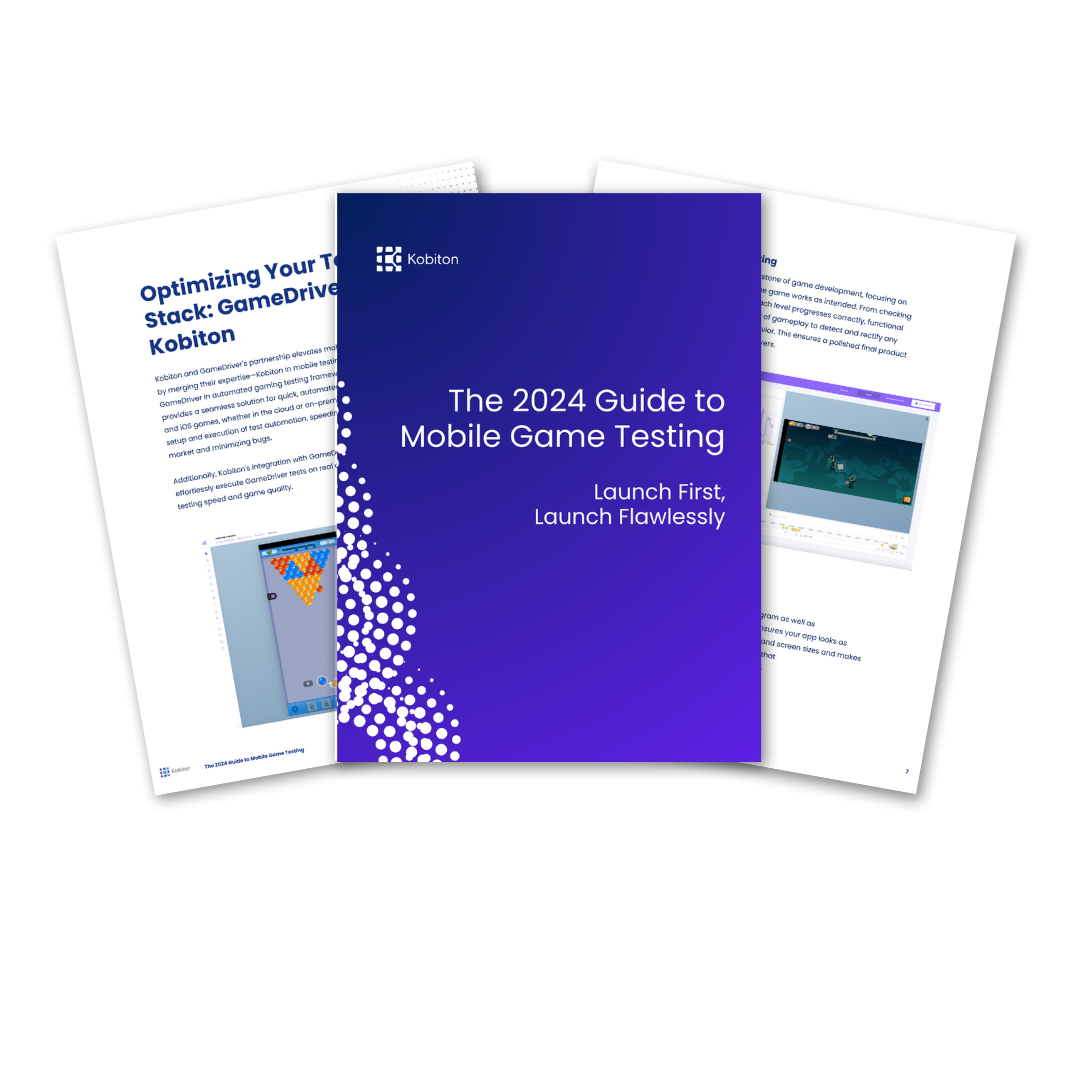
As we shared in our recent “2024 Guide to Mobile Game Testing” it’s essential to evaluate a number of factors to ensure the selection of the right tool for your mobile app testing needs.
Ensure that the mobile testing tool is compatible across different platforms and operating systems to support testing on a wide range of devices. Integration with other tools in your tech stack is key.
Choose a tool that offers scalability to accommodate testing needs as the application grows, allowing for flexibility and adaptability to changing requirements.
Look for tools that provide ease in creating test scripts, enabling efficient test creation without unnecessary complexity or technical barriers.
Opt for a mobile testing tool that is easy to set up and maintain, streamlining the testing process and reducing overhead in managing the tool.
Consider the pricing of the tool in relation to your budget and the features it offers, ensuring that it aligns with your resources and testing requirements.
Ensure seamless integration of the mobile testing tool with your Continuous Integration/Continuous Deployment (CI/CD) tools to streamline the testing process within your development pipeline.
Emulators and simulators are fine for fast feedback during development, but they cannot reproduce everything: hardware-specific rendering, camera and biometric flows, battery and thermal behaviour, and real network conditions. Check whether a tool gives you real devices, how current its device and OS inventory is, and whether it can run on the specific models your users own.
A failed test is only useful if someone can quickly work out why. Look for logs, screenshots, video recordings and performance data captured on every run, and for reports you can share across QA and development without exporting everything by hand.
Be honest about who will write and maintain the tests. Native frameworks and Appium assume developers comfortable with code and test infrastructure. Low-code and scriptless tools let manual testers contribute from day one. A tool your team cannot maintain will be abandoned, however powerful it is.
Native, hybrid, React Native, Flutter and mobile web apps all favour different tools, and your project may add its own requirements, such as on-prem deployment for security or support for specific gestures and device features. Match those needs to the tool’s capabilities before comparing anything else.
There is no single best mobile app testing tool, only the best fit for what you are building and who is doing the testing. Start with your app, then your team.
| If your app is… | Start with | Why |
| Android only | Espresso | Runs inside the app process, so tests are fast and stable |
| iOS only | XCUITest | Apple’s own framework, tightly integrated with Xcode |
| Native on both iOS and Android | Appium | One test codebase across both platforms |
| React Native | Detox or Maestro | Detox syncs with app state to cut flakiness; Maestro is quicker to set up |
| Hybrid or WebView-heavy | Appium or a low-code platform such as Katalon Studio | Handles both the native and web layers |
| Your situation | What to look for | Tools to consider |
| Small team, limited budget, experimenting with automation | No licence cost, strong community | Appium, Espresso, XCUITest, Maestro |
| Manual testers moving into automation | Low-code authoring, or scripts generated from manual sessions | Kobiton, Katalon Studio, testRigor, Tricentis Testim Mobile |
| Existing framework suite, but device coverage is the bottleneck | Real devices at scale, parallel runs, CI/CD integration | Kobiton, Perfecto |
| Enterprise with security or compliance requirements | Private or on-prem devices, access controls, audit-ready reporting | Kobiton (on-prem and hybrid), Perfecto |
| Releasing constantly through CI/CD | Parallel execution, pipeline integrations, fast feedback | A framework plus a real-device platform |
One more piece of advice: if you already have a stable Appium or native suite and your only frustration is access to devices, you probably do not need a new authoring tool. Keep your tests and add real-device infrastructure. Switching authoring tools is worth it when maintenance load or onboarding manual testers is the real problem.
There isn’t one best tool for every team. Espresso is the strongest default for native Android, XCUITest for native iOS, and Appium when you want one codebase across both. Teams moving from manual testing often do better with a low-code or scriptless platform, and teams whose bottleneck is device coverage need a real-device platform such as Kobiton. See the decision tables above to match a tool to your situation.
Yes. Appium, Maestro, WebdriverIO and most commercial platforms, including Kobiton and Katalon Studio, support both. Espresso and XCUITest are each limited to one platform, so teams using native frameworks maintain two separate suites.
Emulators and simulators are fine for most functional checks during development. Real devices matter for anything the hardware affects, including performance, battery, camera, biometrics, GPS and real network conditions, and for final validation before release. Many teams run most tests on emulators and a focused real-device pass before each release.
For many teams, yes. Appium, Espresso and XCUITest are mature and widely used. The cost moves from licences to engineering time: you build and maintain the device infrastructure, reporting and CI setup yourself. Commercial platforms are worth it when that setup work, device coverage or onboarding non-developers becomes the bottleneck.
Yes. Appium remains the most widely used open-source option for cross-platform mobile automation, and most commercial real-device platforms, Kobiton included, run Appium tests. Its main trade-offs are slower execution than native frameworks and more setup.
Low-code and scriptless tools lower the barrier most, because testers can create tests without writing code. Tools that turn manual test sessions into automated scripts, such as Kobiton, are especially useful for QA teams with strong manual testing skills.
In wrapping up our exploration of the best mobile app testing tools in 2024, it’s clear that the landscape is rich with options tailored to diverse development needs. From the AI-driven prowess of Kobiton, facilitating seamless real device and cloud-based testing, to the cross-platform capabilities of Appium and the specialized focus of tools like Espresso and XCUI Test, developers have a wealth of resources at their fingertips. As technologies evolve, choosing the right tools becomes crucial for ensuring app compatibility, performance, and user satisfaction. Embrace these advancements, and consider how tools like Kobiton can streamline your mobile testing strategy.
Interested in trying Kobiton for yourself?
Request a trial today, and a member of our team will reach out to grant you access to our platform.