Oct 8, 2026
Top Mobile App Testing Tools: An Honest 2026 Comparison
Stephen Penn
Read More
Every conversation about AI mobile testing eventually arrives at the same nervous question, usually in a budget review: if AI can write the code and check its own work, do we still need a test team? I have watched experienced QA professionals ask it about their own jobs. The anxiety is real, and pretending it isn’t would be insulting. So here is my honest answer, after twenty years in and around this industry. The role of the tester is not dying. The old workflow might be. And the need for mobile app testing is going up, not down.
I have heard “the traditional tester is dead” at every major technology inflection I can remember. We still have testers.
The prediction has a rhythm to it. Record-and-playback tools were going to let anyone automate, so why keep specialists? Then codeless and no-code automation arrived and the same eulogy ran again. Offshoring was going to make domestic test teams obsolete. Shift-left was going to hand the whole thing to developers. Each wave was sold as elimination. Each one changed the job instead of ending it.
The pattern is not specific to testing either. Radiology got pattern-recognition software decades ago and still has radiologists. Trading floors automated about as aggressively as any industry ever has, and still employ people to decide what the models are allowed to do. In both cases the tooling absorbed the repetitive detection work, and the job moved up into judgment, accountability, and the cases the model was not confident about. That is the same shape as the change in front of us, and it is worth keeping in view the next time the eulogy runs.
That history is not a reason to dismiss AI. AI is a bigger shift than any of those, and I think it changes the work more than the others did. But the pattern tells you how to read the moment. When you hear “AI kills testing,” translate it to “AI changes testing,” because that is what actually happened every previous time the death notice went out. The teams that treated each wave as a change to adapt to came out ahead. The ones that froze got hurt. This time is no different in that one respect, even if the technology is.
The shift-left promise was simple: push testing earlier, closer to the people writing the code. Some of that happened, and it was good. Developers own unit tests now in most healthy engineering orgs. That is real progress.
Here is where it stopped. Unit tests. Outside of that, the shift never really arrived. End-to-end testing, integration testing, real-device testing, cross-platform coverage, exploratory testing, the messy validation of an actual user journey on an actual phone, none of that meaningfully moved into developers’ hands. It still needs an owner, and that owner is QA.
A QA engineer at a healthcare technology company put the tension well on a call. He said people are becoming developers now, that this is what shift-left looks like in practice. In the same breath he admitted he did not see himself living inside code-heavy automation. Both things were true. The shift is real, and the human-skill gap it creates is also real. Somebody still has to manage the tests, decide what end-to-end coverage means for a release, and own the parts of quality that a unit test never touches.
For a leader, this is the reframe that matters. Shift-left never meant “no test team.” It meant unit tests for developers, and everything harder than that still needs you.
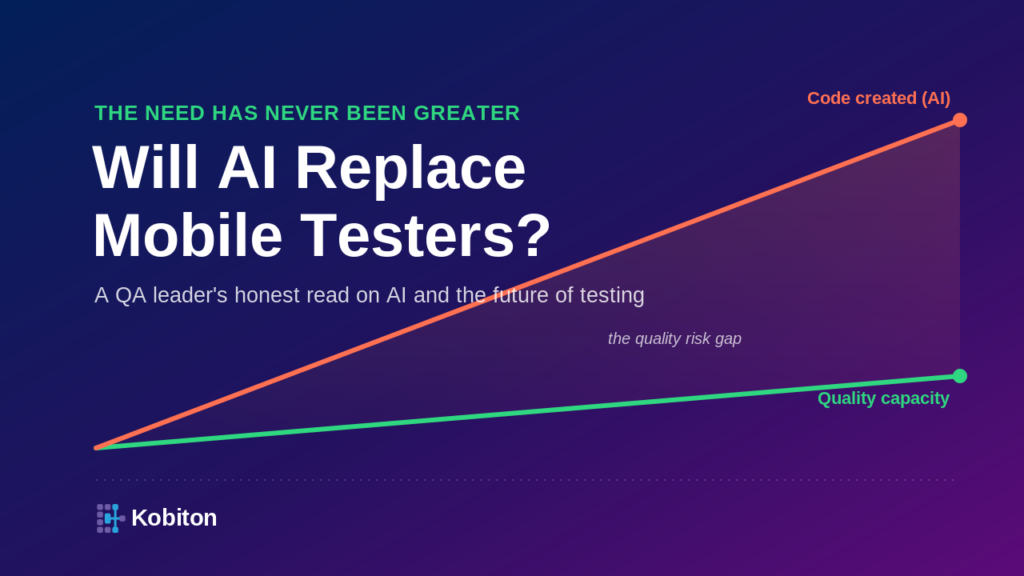
Now the part most people get backwards. The instinct is that AI reduces the need for testing because machines can check machine-written code. The opposite is true, and the reason is simple economics. When developers lean on assistants like Claude Code to produce more code faster, creation stops being the constraint. Verification becomes the constraint. Teams now ask whether ChatGPT for mobile testing can carry the QA side at the same pace, and the honest answer is that prompting a model to generate a test is the easy part. Confirming the app actually works for a real user is the hard part, and it is most of the work.
I heard this land in one number. A director of engineering at a global ride-hailing platform described his team going from roughly 10,000 code changes a month to roughly 70,000 after adopting AI assistance. Code creation jumped about sevenfold. His quality capacity did not grow sevenfold. Nothing close. That space between how fast you can ship code and how fast you can trust it is the quality risk gap, and AI is widening it on purpose.
That is one team, but the direction is not unusual. Capgemini’s World Quality Report 2024-25 found roughly two-thirds of organisations already using generative AI in quality engineering, with faster test automation the most commonly named benefit. Read that alongside the velocity numbers and the picture is an industry that has adopted the accelerator considerably faster than it has adopted the brakes.
More code means more surface area, more integration points, more states a user can reach, and fewer human eyes per line. On mobile the problem compounds. AI-generated code can pass its own generated unit tests while nobody has confirmed the feature actually works on a three-year-old Android device, on a spotty network, on the OS version a large share of your users are still running. A green check in a pipeline is not the same as a working app in someone’s hand.
The coverage math makes it worse. As one practitioner described testing across many OS versions and device types, the variety “makes automation a lot more brittle and more difficult to create and scale.” Multiply brittle automation by sevenfold code velocity and you do not get less testing work. You get a flood.
So the leader’s takeaway is the inverse of the fear. AI does not shrink the need for testing. It raises the stakes on it.
I told you this would be the honest version, so here is the uncomfortable part. Some of the fear is justified, just not the part people focus on.
The tester whose entire job is clicking through the same regression script by hand, week after week, and nothing else, should be nervous. That specific workflow is genuinely exposed. AI is good at exactly that kind of repetitive, well-defined execution. If that is all someone does, the market will notice.
But notice what automation already did to that job, long before AI. A QA leader at a connected-hardware manufacturer described it plainly: he had many testers who write automation by hand and then maintain those scripts, and the scripts keep failing. Automation did not free his team. It handed them a new manual job called script maintenance. The brittle test that breaks on every release does not save anyone time. It just moves the busywork.
That is the real story of the threat. It is not the role that is at risk, it is the old way of doing the role. And a leader’s job is not to defend headcount against AI. It is to move the team up the value stack before the market forces the question. The maintenance trap is the clearest place to start, because AI is genuinely good at the thing that has been burning your team’s hours.
Reassurance is cheap, so let me be concrete about what AI-powered mobile app testing changes day to day. The work splits in two.
AI takes the parts that are mechanical and high-volume:
People take the parts that need judgment:
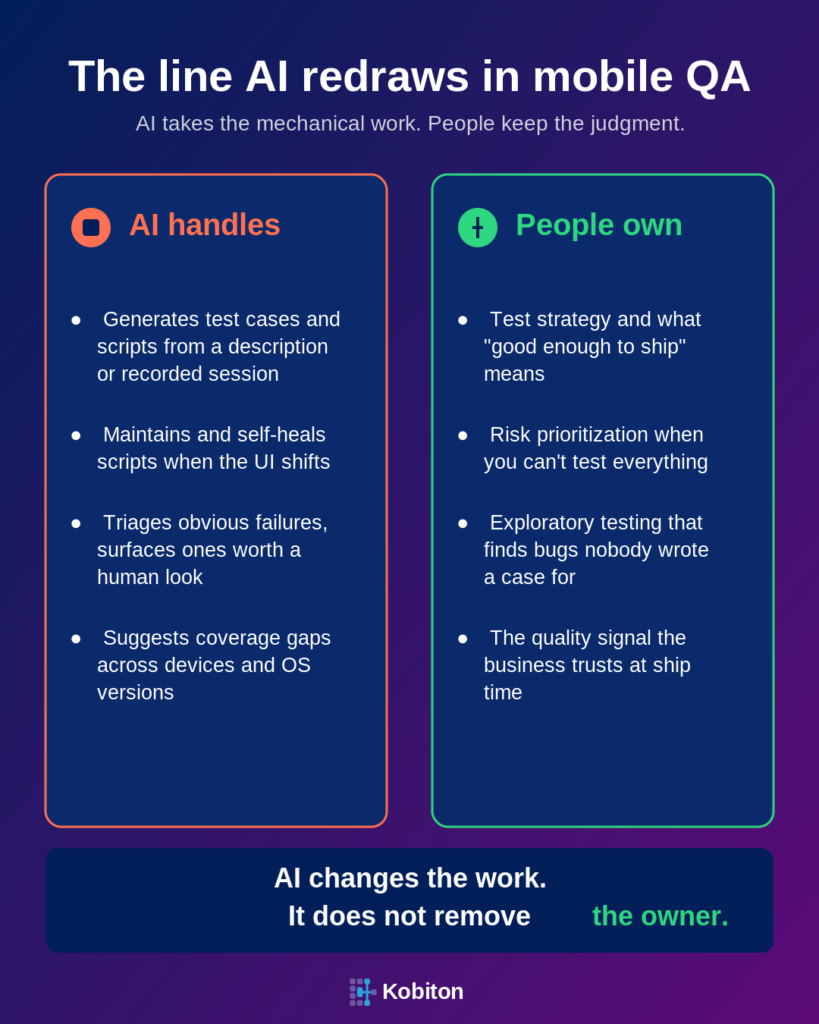
That split looks different depending on which part of your test strategy you apply it to. Some of it is mature; some of it is barely started.
| Test type | What AI can carry now | What stays with your team |
| Functional and regression | Generating cases from a flow description or a recorded session, re-binding locators when the UI shifts, running a risk-weighted subset per build instead of everything | Deciding which flows are release-blocking, and noticing when six months of drift means the suite no longer tests the right things |
| Visual and UI | Comparing rendered screens against a baseline across screen sizes and densities, flagging clipped text, layout breaks and contrast failures | Deciding whether a flagged difference is a defect or an intended redesign, and whether the baseline was any good to begin with |
| Performance | Running a flow under varied network profiles and device states, surfacing the step where launch time, memory or battery spikes | Setting the threshold that counts as too slow for your users, on the oldest device you still support |
| Accessibility | Scanning screens for missing labels, focus-order problems and contrast failures against WCAG | Confirming the app is actually usable with a screen reader in a real flow, which is where most real accessibility failures live |
| Exploratory | Very little. Some tools crawl an app and surface unreachable or broken states, which is a starting point rather than a substitute | All of it. This is the work everything above is meant to buy time for |
There is a quieter upside here that never shows up in a tooling ROI model. Every team has a list of things it knows it should test and never gets to: the rotation edge case, the interrupted-payment path, the flow on the device nobody on the team happens to own. Those do not get skipped because they are unimportant. They get skipped because the regression suite ate the week. Taking maintenance work off a strong tester does not just save hours, it moves those hours to the part of the surface area that has never been properly covered at all.
There is a hard-won lesson in how you introduce this. Remember the engineer who said he did not see himself using code-heavy automation. Adoption fails when “adopt AI” really means “now also become a developer.” The tooling has to lower the skill barrier, not raise it. The win is a strong tester directing AI, not a tester forced to compete with it.
This is the direction real-device AI testing platforms are moving, and it is the gap Kobiton is built to close: run the software on real devices, detect issues, and explain the root cause, with the platform increasingly able to help generate and validate the fix on actual runtime rather than in a simulator. That loop, from detect and explain toward fix and validate, is what an AI-augmented team runs on. The point for this discussion is not the product. It is that the category is finally maturing toward augmenting testers instead of replacing them.
For staffing, that means hiring for judgment, domain depth, and strategic thinking over raw scripting speed, and deliberately reskilling the strong people you already have.
An honest answer has to run in both directions. If I am going to tell you the fear of replacement is overblown, I owe you the list of things the tooling genuinely does not handle, because those are exactly the things your team is still on the hook for.
That last one is the point I would push hardest on with a vendor. A tool that presents every result with the same flat confidence is not being straight with you; it is hiding the cases where it guessed. The behaviour you want is the opposite. When the tool reaches a screen or a state it cannot interpret confidently, it should stop and flag it for a person rather than producing a plausible-looking pass. An AI testing agent that admits its own uncertainty is more useful than one that never appears to have any, because the second kind quietly converts what should have been a caught defect into a green build.
None of this is an argument against adopting AI. It is an argument for knowing exactly where the handoff sits, because the handoff is where your team’s value now lives.
Here is what I would actually do this quarter if I ran a mobile QA team.
None of this requires betting the team on a single vendor or a single year. It requires deciding that the transition is happening and getting in front of it.
Step 5 above is the one that needs unpacking, because almost every platform on the market now says AI somewhere on the page. These are the questions that actually separate them. Take them into the demo and ask for a live answer rather than a slide.
| What to check | The question to ask | Why it separates tools |
| Real-device execution | Do AI-authored tests run on real Android and iOS hardware in parallel, or only on emulators? | Emulators miss the OS version, memory pressure and network behaviour that cause most mobile-only defects. AI authoring on an emulator-only backend moves the bottleneck without closing the risk. |
| Maintenance, not just authoring | When the UI changes, does the tool re-bind the locator itself, or regenerate the script and hand it back to us? | Authoring was never the expensive part. Script maintenance is the tax you are trying to reclaim, so a tool that only speeds up creation leaves the actual problem in place. |
| Confidence reporting | What does the tool do when the model is not sure? | A tool that silently guesses turns a would-be escaped defect into a green build. One that flags low confidence hands the case back to a person who can judge it. |
| Root cause, not just failure | Does a failure come back as 'step 7 failed', or as an explanation of what changed and where? | Triage time, not execution time, is where the hours actually go. A failure list that still needs a human to reconstruct the cause has moved the work rather than removed it. |
| Pipeline integration | Does it trigger on every build through our existing CI, or is it a separate console someone has to remember to open? | Anything out-of-band becomes optional, and optional testing stops happening in the week before a release. |
| Skill floor | Can our strongest domain tester use this without becoming a developer? | Adoption fails when adopting AI turns into also learn to code. The tooling has to lower the barrier, not raise it. |
| Export and lock-in | Can we export generated tests as standard Appium, Espresso or XCUITest code? | Tests you cannot take with you are rented, not owned. Export capability is also the cheapest insurance against a vendor's roadmap diverging from yours. |
| Agent interoperability | Does it expose an MCP server or equivalent so the AI tools our developers already use can query test results? | This is the 2026 version of asking whether it has an API. Teams wiring AI into their development workflow will hit this within a year of adoption. |
A platform that answers all eight well is raising your team's leverage. A platform that answers the first two badly has bolted a chatbot onto the same brittle workflow, whatever the box says.
Most of this is addressed to whoever runs the team, because that is who can change how the hours get spent. But the question that brings people to an article like this one is usually more personal than a budget line, and it deserves a direct answer: what do I actually do about this, starting Monday?
1. Stop defending the script. If the value you offer the business is that you maintain the regression suite, that is precisely the part that is exposed. Move your pitch to what the suite is for — release confidence, and knowing which risks are covered.
2. Get properly good at one AI testing tool rather than sampling five. Depth is what makes you the person the team asks, and it is what turns an abstract worry into a concrete sense of where the tooling breaks.
3. Practise reviewing AI output critically. Generating a test is easy now. Spotting the generated test that passes for the wrong reason is not, and it is the scarce skill of the next few years.
4. Go deeper on the domain, not just the tooling. Nobody can outsource knowing what a correct quote, a correct balance, or a correct checkout looks like in your product. No tool ships with that.
5. Write down what you catch. Escaped defects you prevented, exploratory finds nobody had a case for, releases you stopped. When leadership moves its metrics from activity to outcome, you want a record on the outcome side.
None of that needs permission or a budget line, and all of it moves you toward the half of the work that is getting more valuable rather than less.
Twenty years of "the tester is dead" got it backwards every single time. AI will too, but only for the teams that treat it as a tooling and skills transition rather than a threat to wait out.
The teams that freeze will lose, and they will lose to teams that adopted AI testing early, reskilled their people, and repositioned QA as the function that makes AI-speed development safe to ship. When code creation gets cheap and fast, the organization that can actually trust what it ships wins. That trust is your team's product.
So no, AI did not make testers obsolete. It made testing the thing standing between shipping faster and shipping broken faster. The need has never been greater. The only open question is whether your team adapts to meet it, and that part is still up to you.
No. AI changes the tester's workflow more than it threatens the role. As AI helps developers ship more code faster, verification becomes the bottleneck, so the need for testing rises. The manual-only regression workflow is exposed, but testers who move up to strategy, exploratory testing, and supervising AI tooling become more valuable.
Not necessarily. AI removes repetitive work like script maintenance, which frees existing testers for higher-value work rather than eliminating them. Leaders who reskill their teams and reposition QA as the function that makes AI-speed development safe tend to grow the team's influence, not shrink it.
Audit where the team's hours go, then pilot AI against the biggest time sink, usually script maintenance and repetitive regression. It is the clearest ROI and the least threatening entry point. Reskill deliberately and shift metrics from activity to outcomes like escaped defects and release confidence.
Only partly. Developers own unit tests, but end-to-end, integration, real-device, cross-platform, and exploratory testing never meaningfully shifted left. Those still need a dedicated owner, which is why AI raises, rather than removes, the need for a QA function.
Traditional automation runs scripts you wrote, exactly as written, until something in the UI moves and they break. AI mobile testing adds three things on top: it generates cases from a description or a recorded session, it re-binds locators itself when the UI shifts, and it prioritises which tests to run based on what actually changed. Execution still happens through frameworks like Appium, Espresso or XCUITest underneath. What changes is how much human time sits around the run.
It cannot tell you whether a screen is well designed, only whether it changed. It cannot supply the business context behind a risk decision. It cannot do exploratory testing, which depends on a tester suspecting something is wrong before there is evidence for it. And it cannot be relied on to be certain the tools worth buying are the ones that flag low confidence rather than returning a plausible-looking pass.
Pick one AI testing tool and get genuinely good at it rather than sampling five. Then work on the skill that is actually scarce: reviewing AI-generated tests critically enough to catch the one that passes for the wrong reason. Domain depth compounds on top of both, because knowing what correct looks like in your product is the one thing no tool ships with.