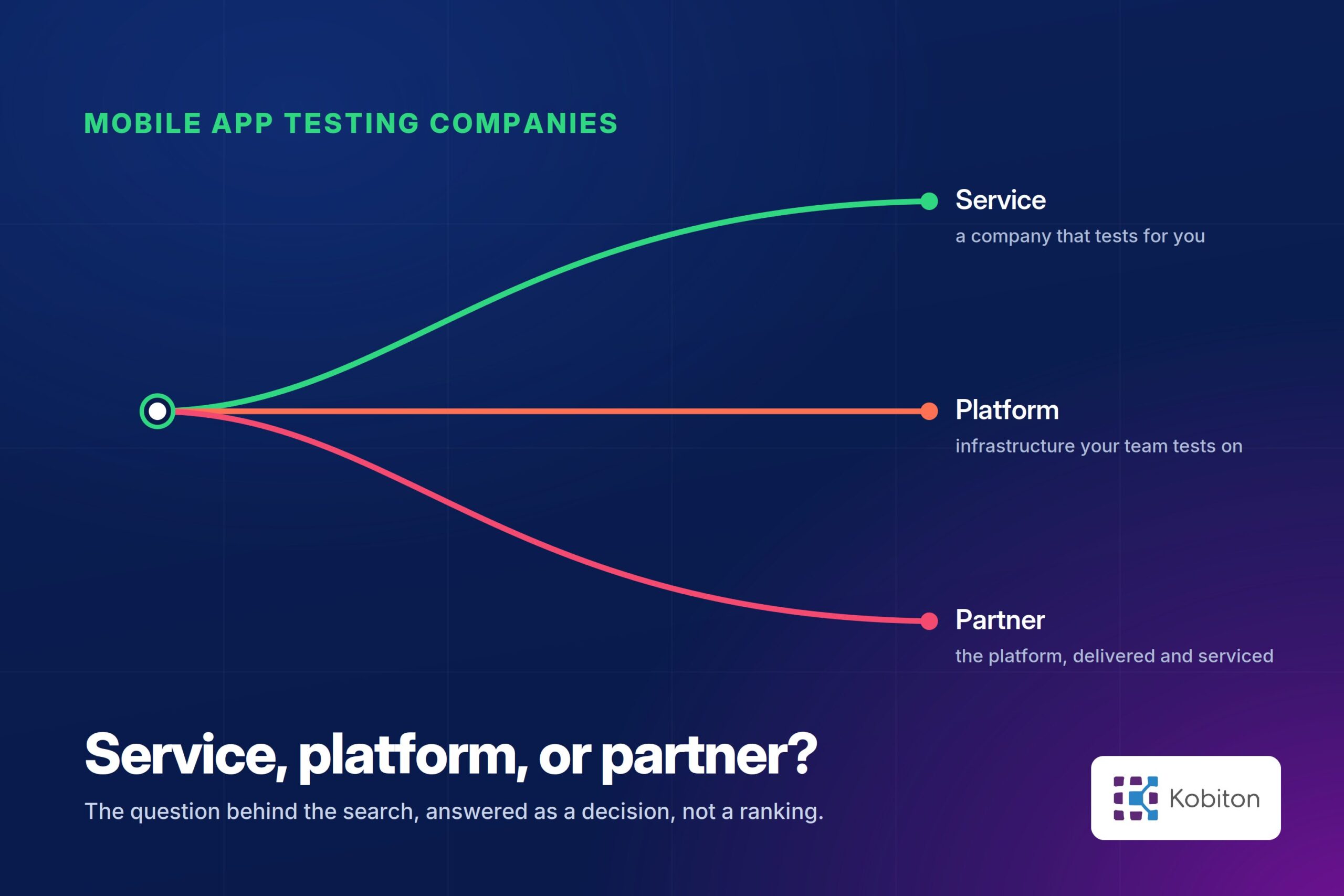
Search for mobile app testing companies and you get a ranked list of ten names, and the list almost never separates the two things you could actually be buying: people to test your app, or infrastructure your own team tests on. Those are different purchases, and a ranking that mixes them produces a winner nobody can defend.
So this guide does two things most lists skip. It names the companies and compares them, grouped by what you are actually buying. And it does not rank them, because there is no single best one, only the best fit for a decision only you can make. We publish this list and we are on it, so we name where each company is the wrong fit, ours included.
How to read this list
We do not rank these companies, and the order is alphabetical within each group on purpose. The right choice depends on whether you want a platform your team runs or a service that runs testing for you, and then on your stack, your deployment constraints, and your budget. What we weigh when we compare them is real-device depth, deployment flexibility, platform and framework coverage, automation and AI maturity, and compliance. Kobiton publishes this list and is on it, measured the same way as everyone else, with its own limits named.
This page is about choosing the kind of company and the relationship. If you want a feature-by-feature comparison of the platforms themselves, that is a different question and we answer it in the top mobile app testing tools, compared. For the wider stack, including frameworks and authoring tools, see the best mobile test automation tools.
What teams actually come for
In the evaluations we run, the deciding factor is rarely a device count. It is almost always one of a few things, and each is a place a shared public cloud tends to run out of room.
- Deployment the public clouds cannot offer. A banking team ruled out a cloud-only vendor because it had no on-premise option. A regulated enterprise needed to bring its own devices under its own MDM, not rent seats in a shared marketplace. This is the single most common reason teams reach out, and the clearest line between the platforms below.
- Real devices, not emulators. A fintech team moved to real devices because emulators could not get the job done on the flows that decide whether they ship. A globally distributed team needed devices available across time zones, not a handful of shared seats that queue up.
- Offline and carrier behavior. A building-materials company needed offline device functionality its public-cloud platform could not give it. A messaging platform needed SIM-enabled devices for carrier and RCS testing its incumbent was not investing in.
- A real path off manual. Teams stuck in manual testing come for scriptless capture and Appium scripts generated from a manual session, which they can run anywhere with no vendor lock-in. That combination, not a bigger device list, is what moves a manual-heavy team to automation.
- Tooling that actually delivers. One team switched platforms after a prior vendor’s AI features proved inefficient in practice. Another was running a heavy enterprise stack it still could not stand up for mobile. Depth on a datasheet is not the same as depth you can operate.
Every one of these maps to a limit named in the comparison below. That is the point of reading the list by what you are buying rather than by rank.
The companies, by what you are buying
Platforms, when your team runs the testing
You keep ownership of the tests and rent the hard part: real devices, parallel execution, and somewhere reliable for your automation to run.
BrowserStack. Best for broad public-cloud device coverage and the widest framework support, with live manual sessions and strong CI integration. The limit: mobile app testing is cloud only. Its self-hosted option covers desktop browsers, not mobile apps.
HeadSpin. Best for measuring real-network performance from real locations, SIM-enabled across many countries, with a genuine air-gapped tier. The limit: the air-gapped tier ships a vendor VPN tunnel for updates and support that you toggle off, so if your requirement is no vendor path at all, get the tier named in writing. Packaging is less publicly documented.
Kobiton. Best for real-device depth across every deployment model, public cloud, private cloud, hybrid, and fully on-premises including air-gapped with no vendor access path required. It is the only platform that generates Appium scripts from a manual session, and it adds scriptless and AI-assisted automation, Appium support, and an MCP server to drive tests from an AI agent. The limit: the public device cloud is smaller than the largest clouds here, we are not marketing an end-to-end agentic authoring agent at the scale of the most AI-forward vendor, and running on-premises means running a device lab.
Perfecto. Best for the feature depth regulated enterprises ask for, in public or private cloud, with a long track record in financial services. The limit: its “devices on your premises” option is hybrid, the control plane stays hosted by Perfecto, so it is not true on-premise or air-gapped, and the platform is heavy for a small team.
pCloudy. Best for flexible deployment, available in public cloud, private cloud, and inside your firewall. The limit: it is less commonly on enterprise shortlists than the larger platforms here, so confirm current device coverage and support depth.
Sauce Labs. Best for enterprise scale and surviving a long procurement review, with real devices plus emulators and simulators and broad framework support. The limit: execution is cloud only with no on-premise path, and cost climbs at scale, so model it against your real concurrency.
TestMu AI (formerly LambdaTest). Best for AI-first, plain-English test authoring across a very large cloud, with self-hosted and air-gapped execution. The limit: the AI still needs connectivity to its own APIs, so in an air-gapped deployment you get the execution platform without the capability it is named for. The company rebranded from LambdaTest in January 2026.
Services, when you want someone to run it for you
You are buying an outcome: a test plan, execution against it, and defects filed. Plenty of teams with their own QA still use one for extra capacity or specialist coverage.
Applause. Best for broad, real-world, and localized coverage through managed crowdtesting on real devices worldwide, mixing real testers with AI and automation.
Global App Testing. Best for on-demand localized functional and exploratory testing across a large international tester network, with a platform for planning and coordination.
Testlio. Best for managed testing delivered as an outcome, blending vetted human testers with automation across a wide real-device range, including team extension for groups that already have QA.
Among managed QA services firms with access to real devices, a1qa, DeviQA, Kualitatem, and TestingXperts are also worth shortlisting when you are outsourcing the full QA function rather than buying platform access.
The companies compared
| Company | Type | Real-device access | Deployment | Automation and AI | Best for |
|---|---|---|---|---|---|
| Applause | Service | Real devices, crowdsourced | Managed | Testers plus AI and automation | Broad real-world and localized coverage |
| BrowserStack | Platform | Real devices, plus vendor-hosted dedicated | Public cloud; vendor-hosted dedicated devices | Appium, Espresso, XCUITest, Maestro; cloud AI agents | Broad public-cloud device coverage |
| Global App Testing | Service | Real devices, crowdsourced | Managed | AI-assisted planning and crowd coordination | On-demand localized functional testing |
| HeadSpin | Platform | Real devices, SIM-enabled in many countries | Shared and dedicated cloud; on-prem incl air-gapped (vendor VPN toggle) | Plain-English authoring; performance and network analytics | Real-network performance and experience data |
| Kobiton | Platform | Real devices, public and private | Public, private, hybrid, on-prem incl air-gapped (no vendor path) | Scriptless and AI; Appium; script generation from a manual session; MCP | Real-device depth across every deployment model |
| Perfecto | Platform | Real devices, shared or dedicated | Public and private cloud (on-prem devices is hybrid; no air-gap) | GenAI authoring, scriptless, self-healing; cloud | Regulated-industry feature depth |
| pCloudy | Platform | Real devices | Public cloud, private cloud, in-firewall | Automation with AI features | Flexible deployment |
| Sauce Labs | Platform | Real devices, plus emulators and simulators | Public cloud; private dedicated devices (no on-prem) | No-code authoring and self-healing; cloud | Enterprise scale and procurement maturity |
| Testlio | Service | Real devices, via managed testers | Managed | Blended manual and automation | Outcome-delivered managed testing |
| TestMu AI (formerly LambdaTest) | Platform | Real devices | Public, private, on-prem; air-gapped execution | AI-native, plain-English authoring (needs connectivity) | AI-first authoring at scale |
Deployment and AI change fast here, so confirm anything decision-critical with the vendor before you sign. For how those deployment words differ, public cloud, private, hybrid, on-premises, and air-gapped, see which cloud mobile app testing model your security team can approve.
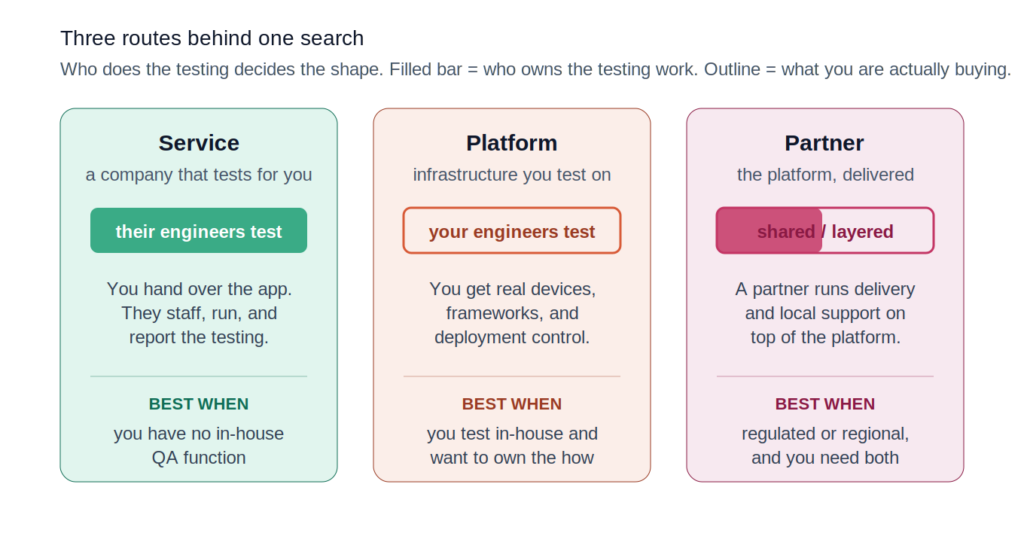
Service, platform, or both: three kinds of mobile app testing company
There are three kinds of company you can hire, and they are not interchangeable. Almost every vendor you shortlist is one of them, and knowing which one you need eliminates most of your list before you book a single demo.
A services shop, when you have no QA function to run
If you have no in-house QA team and no plan to build one, hire a service, not a platform. That is worth saying plainly on a platform vendor’s own blog: if you cannot staff it, our kind of product is not what you need.
The signals are specific:
- You have developers who ship and nobody whose job is testing.
- Your release cadence is monthly or slower, so a fixed test cycle fits your rhythm.
- You need someone accountable for coverage, not a tool that makes coverage possible.
- Nobody on staff writes or maintains automation, and hiring for that is not funded.
Under those conditions a platform is a liability. You will pay for capacity you cannot staff, and six months later the seats will sit idle while your releases still go out untested. A mobile app testing service provider sells you outcomes: a test plan, execution against it, and defects filed. That is what you are short of. Buying mobile software testing services means buying that accountability, not the tooling underneath it.
Be honest with yourself about the staffing question in particular. “We will hire an automation engineer next quarter” is the assumption I have seen sink more platform purchases than any technical gap.
A platform, when your team tests in-house
If you already have QA engineers writing tests, you are not buying testing. You are buying the infrastructure underneath it, and the requirements change completely.
You need real iOS and Android devices your team can reach remotely, because simulators and emulators can simulate many of these inputs but cannot faithfully validate the defects that matter on real hardware: hardware-backed biometrics, real push delivery, actual camera and sensor behavior, genuine radio and network conditions, device-specific rendering. You need your existing framework supported with minimal migration, whether that is Appium, XCUITest, Espresso, or a scriptless layer on top, and you should make a vendor show you the exact integration changes rather than take unchanged for granted. You need parallel execution so a full regression fits inside a release window instead of overrunning it. You need it to sit in your CI pipeline rather than beside it. And in regulated environments you need to control where it runs: on premise, private cloud in your own region, or hybrid.
If that describes you, your next question is not what kind of company to hire. It is which platform. That is a separate comparison, and we have written it: the top mobile app testing tools, compared.
Both, which is how regulated and regional enterprises actually buy
The third option is the one the ranked lists never show, and it is one established way enterprise deals get structured: you buy the platform, but a services partner or systems integrator sets it up, runs it for the first year, and hands it over to your team.
In plain terms: you own the tool long term, but someone else stands it up and operates it while your team gets up to speed.
It exists because the two gaps are different. The enterprise wants to own its testing long term but has no capacity to stand the practice up. The partner brings people who already know the platform, runs the first year, and hands over. In regulated and regional markets the partner often also carries the local relationships, the compliance paperwork, and the procurement approvals that a foreign vendor would spend a year acquiring.
Buyers describe it this way, not vendors. An account lead at a global systems integrator opened an evaluation by asking about licensing structure so their firm could “take along with us when we are putting in our solutions,” and to “put a go to market strategy” around it. The integrator was not buying testing for itself. It was assessing a platform it would deliver to its own clients.
You will not find that layer on a comparison page, and it changes what you ask for. If you buy this way, your platform contract and your delivery contract are separate negotiations with different failure modes.
So which are you
Three questions settle it.
- Do you have people who will run the testing? If no, hire a service.
- Do you have people who write automation and want to keep owning it, and can you deploy the way your security review requires? If yes to both, buy a platform.
- Do you want to own it eventually but cannot staff it now, or do you have a deployment or data-residency constraint a raw subscription will not meet? Buy a platform, delivered through a partner, with a handover date written into the contract.
It is common to arrive searching for mobile application testing companies, land in the second or third case, and realize you had been evaluating the first.
Signs you are about to pick the wrong kind
Those three questions are about you. These are about the vendor. Most of these tells show up on a first call, before you have asked anything hard. The last one shows up in the contract.
- A platform where only the vendor’s engineers can change or rerun your tests is a service with a platform’s price tag.
- A demo that only ever runs in the vendor’s account proves nothing about setup and staffing. Ask for a trial in yours, and have your own team run a real test.
- A service that cannot show you the report you would get, even one built on a demo app, is selling testers, not testing.
- A platform vendor who never asks who on your team will run the testing is selling seats, whether or not you can staff them.
- A partner deal with no handover date or milestone in the contract is a service that never ends. Get it in writing: who owns the tests, who fixes a broken one, and when you take over.
The four questions near the end of this guide make a vendor say the ownership part out loud.panies, land in the second or third case, and realize you had been evaluating the first.
What serious buyers ask mobile app testing companies for
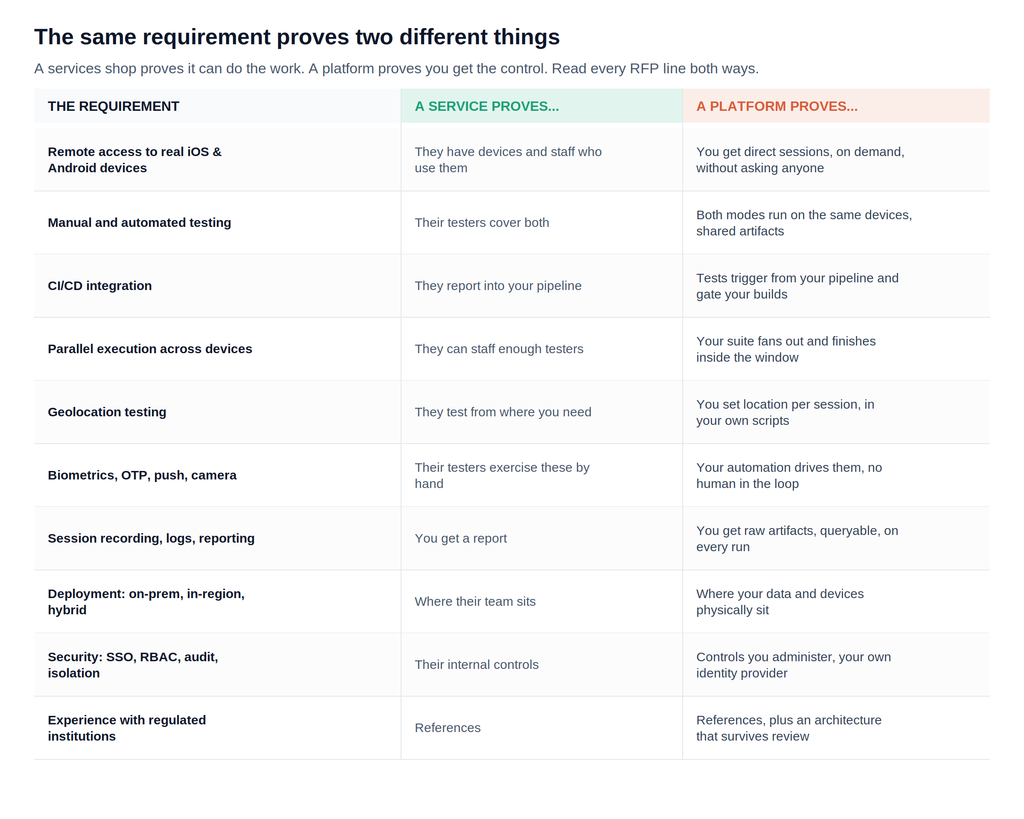
The evaluation criteria below are the kind of rubric a regulated enterprise sends out. Nobody writes these for marketing. They get attached to an RFP, and every line has to be answered in a formal response.
The list is not what makes it useful. Every ranking page publishes some version of it. The value is that each line means something different depending on whether you are buying a service or a platform. A services shop answers “we do that.” A platform answers “here is the control you get.” Same requirement, two different proofs, and the evaluations that go wrong are the ones that accept the first answer when they needed the second.
| The requirement | What a service is proving | What a platform is proving |
|---|---|---|
| Remote access to real iOS and Android devices | They have devices and staff who use them | You get direct sessions, on demand, without asking anyone |
| Manual and automated testing | Their testers cover both | Both modes run on the same devices, with shared artifacts |
| CI/CD integration | They can report into your pipeline | Tests trigger from your pipeline and gate your builds |
| Parallel execution across devices | They can staff enough testers | Your regression suite fans out and finishes inside the window |
| Geolocation testing | They can test from where you need | You set location per session, in your own scripts |
| Biometrics, OTP, push notifications, camera | Their testers exercise these flows by hand | Your automation drives them without a human in the loop |
| Session recording, logs, screenshots, reporting | You get a report | You get the raw artifacts, queryable, attached to every run |
| Deployment model: on premise, private cloud in-region, hybrid | Where their team sits | Where your data and your devices physically sit |
| Security: SSO, RBAC, audit logs, session isolation | Their internal controls | Controls you administer, against your own identity provider |
| Demonstrated experience with regulated institutions | References | References, plus an architecture that survives your review |
Three of those lines are the ones I would press on first, because they disqualify vendors fastest.
Deployment model. This is the line that most often disqualifies a vendor late, after everyone has already fallen in love with the demo, especially in regulated environments. If your security review requires devices inside your own perimeter, or data that never leaves your region, ask on the first call. Not the fifth. A vendor whose only answer is a public multi-tenant cloud is not a candidate, and finding that out in month three of a four-month process costs you the whole cycle.
Parallel execution. Most vendors claim it. The real question is what happens at the scale you will actually run. Take your full regression suite from three devices at once to thirty, and ask two separate things: does it still finish inside your release window, and what does that run cost. A services shop is limited by how many testers it can put on the job. A platform is limited by its capacity model. That is where the two diverge.
Security and access control. SSO and RBAC are table stakes on the answer sheet. Session isolation is not. In a shared device estate, ask what happens to your app, your credentials, and your data on a device between your session and the next tenant’s.
Compliance evidence is the paperwork behind that security line, and regulated buyers screen on it before they watch a demo. Read it both ways, like every other line on the rubric. From a service, the evidence has to cover people: who on their staff touches your builds and test accounts, and what happens to your app on their devices afterward. From a platform, it has to cover the system your team will log in to. With a partner, you need both, from two different companies.
Know which documents to ask for. They are not all certifications, and trust pages tend to blur the difference.
- SOC 2 Type II. An independent auditor’s report on whether the vendor’s security controls actually worked over a period of months. Type I only looks at how the controls were designed on a given date. Ask for the report, not the badge. Check the period it covers and the exceptions the auditor listed.
- ISO 27001. A certified information security management system. Buyers in the EU and large global enterprises often ask for it alongside SOC 2, or instead of it. Ask for the certificate and what it covers.
- HIPAA. There is no official HIPAA certification. If the vendor will handle protected health information on your behalf, what you need is a signed Business Associate Agreement.
- PCI DSS. It can apply when real cardholder data reaches the test environment, or when that environment can affect the security of the systems that handle it. Keep real card data out and use the test card numbers your payment processor provides. Then have your security team confirm the scope. If the vendor is in scope, ask for its PCI DSS Attestation of Compliance.
- GDPR and data residency. A certification does not replace the contract here. If the vendor processes personal data for you, get a data processing agreement, and ask where test data, session recordings, and logs are stored and processed. That ties straight back to the deployment-model line above, and to which deployment model your security team can approve.
Last, check what each document covers. A report covers a named company and a named set of systems. Confirm it covers the product and the deployment model you are buying, not a different product line.
One more line belongs on your rubric that will not be on theirs: how the thing is licensed. Licensing can fragment fast, automation as one line item, an AI capability as a second, accessibility as a third, when what you wanted was one tool across your teams and projects. Ask for the full shape of it in writing during the evaluation, while you can still get a direct answer, because clarification gets slower once formal procurement owns the conversation.
What a mobile app testing company costs, and what sets the number
What a mobile app testing company costs depends on which of the three kinds you hire. A service bills for people’s time. A platform bills for capacity or usage. With a partner, you pay for both. The licensing line above is one piece of that. A list price is a starting point, and the total depends on your workload and who runs the testing. What you can pin down early is the shape of the cost, because the shape tells you where a quote will grow later.
| Route | How it is priced | What drives the number |
|---|---|---|
| Service (a QA firm tests for you) | By project, on a monthly retainer, or by tester time | Scope, how many testers, how many test cycles per release, and how specialized your domain is |
| Platform (your team tests on it) | A subscription or pay as you go. Plans charge by how many devices or sessions you run at once, by users, or by device minutes. Dedicated and on-premise devices are usually priced separately | How many tests you run in parallel, how much you run each month, and which deployment model you need. Per-feature line items sit on top of that |
| Partner (a platform, stood up and run for you) | The platform license plus the partner’s delivery work for setup and the first year. Sometimes that is two contracts, and sometimes the partner bundles both into one. Ask which | The handover date, how much of the first year the partner runs, and the local compliance and procurement work they carry |
Each route has a trap worth pricing in before you compare quotes.
With a service, check how many test cycles the quote includes. A cheap quote has often scoped fewer cycles than your release cadence needs, and the gap comes back as change requests once the work starts.
On a platform, get the quote at the concurrency you will actually run. On a metered plan, estimate your monthly device minutes too. The quote also leaves out a cost that is often bigger: your own team’s time to write, run, and maintain the tests.
With a partner, the cost that gets missed is the year after handover: the platform renewal, any partner support you keep, and the work your team takes on.
Whichever route you are on, give every vendor the same workload and term: the devices you need covered, the test cycles, the peak concurrency, the expected usage, and the contract length. Then ask for the price list behind each quote. From a service, that is the rate card. A quote prices one scenario. The price list shows what the next one costs. Quotes built on different assumptions cannot be compared, and procurement will compare them anyway.r-onboarding steps before the RFP even goes out, which can add weeks or months at the front, depending on the organization.
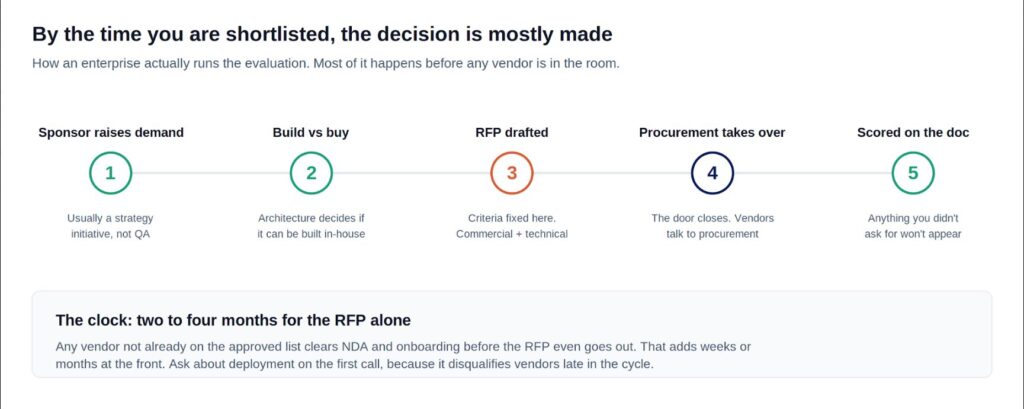
How enterprises actually choose a mobile app testing company
Everything above assumes you control the evaluation. In an enterprise, mostly you do not. This is what the process does around you, and it is worth knowing because most of it is outside your influence once it starts.
The bank architect quoted at the top of this post described the full pipeline in one answer. It runs in a fixed order.
A sponsor raises the demand, usually as a strategy initiative rather than a QA request. The architecture function runs the build-versus-buy assessment. If the conclusion is buy, the team identifies which vendors to approach, and drafts an RFP that includes the criteria and asks for commercial and technical proposals together.
Then the door closes. In their words, “procurement is leading it,” and from that point the vendors talk to procurement rather than to the people who wrote the requirements. They were direct about what that means for both sides: the evaluators no longer see who is asking what, and the vendors no longer reach the evaluators.
Timelines can run longer than teams plan for. Asked how long the cycle runs, they gave a range rather than a number.
“It may take four months, it may take two months.”
Enterprise architect, regulated bank
That range covers the RFP alone. Any vendor not already on the approved list has to clear NDA and vendor-onboarding steps before the RFP even goes out, which can add weeks or months at the front, depending on the organization.
Two things follow from that shape, and neither is a tactic.
The criteria are the decision. Once they are written into the RFP, the evaluation is a scoring exercise against a document. Anything you failed to ask for is not going to appear later.
The vendor’s ability to explain itself also expires. After procurement takes over, everyone is compared on written responses. A vendor who would have won a technical conversation loses to one who writes better RFP prose, and you never find out.
The 2026 question: can your testing keep pace with your developers?
Here is what changed, and it is not the vendor list.
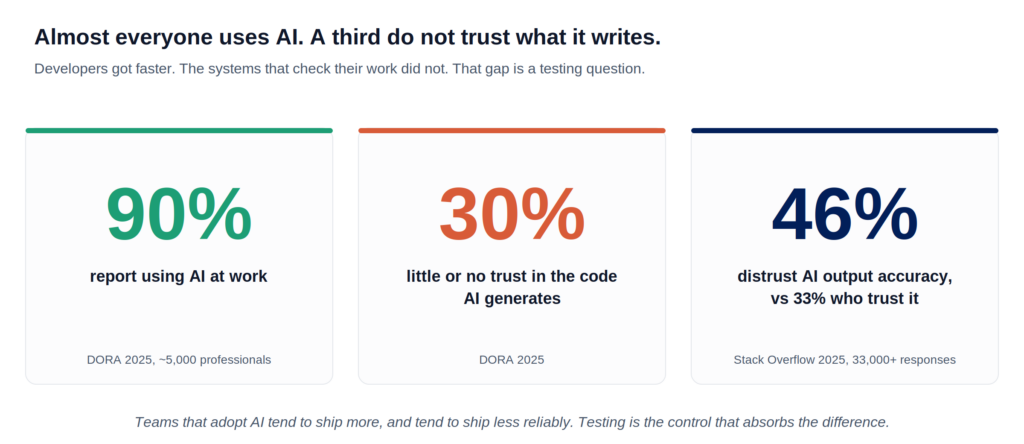
DORA’s 2025 report, State of AI-assisted Software Development, surveyed nearly 5,000 technology professionals. Ninety percent of them report using AI at work, and more than 80 percent believe it has increased their productivity. Thirty percent report little or no trust in the code AI generates.
Read those three numbers together. Almost everyone is using it, most of them feel faster, and a third do not trust what comes out.
That last figure is not an outlier. The 2025 Stack Overflow Developer Survey, run independently and drawing more than 33,000 responses to its AI questions, found that more developers actively distrust the accuracy of AI tool output, at 46 percent, than trust it, at 33 percent. About 3 percent report high trust.
Delivery data tells the same story. DORA found a positive relationship between AI adoption and software delivery throughput, and at the same time a continuing negative relationship with delivery stability. The throughput half is new: unlike last year, the 2025 data shows AI adoption relating positively to both delivery throughput and product performance. Read as DORA states it: AI adoption relates positively to delivery throughput and negatively to delivery stability. Teams that adopt it tend to ship more, and tend to ship less reliably.
One sentence in the write-up should change your evaluation:
“AI accelerates software development, but that acceleration can expose weaknesses downstream. Without robust control systems, like strong automated testing, mature version control practices, and fast feedback loops, an increase in change volume leads to instability.”
Google Cloud, announcing the 2025 DORA report
That is not a claim that AI writes bad code. It is a claim about absorption. Your developers got faster at producing changes and the systems that check those changes did not get faster at absorbing them. Automated testing is the first control named in that list, ahead of version control and feedback loops. DORA does not rank them, but it puts automated testing among the controls that decide whether extra change volume turns into throughput or into incidents.
This is why the gap is easy to misread. It does not show up as a slowdown you can point at. It shows up as more change failures, more rework, and longer restores, which teams attribute to complexity or bad luck. The conclusion some draw is that testing is the bottleneck and should be reduced. The data points the other way. If change volume is rising and stability is falling, the question to answer is whether your testing can keep pace with that volume, which you settle by measuring your own regression time, failure feedback, and coverage against your new release speed, not by cutting the check that catches the errors.
So the question to put to any vendor is not who has the most devices. It is whether the partner you pick lets your testing keep pace with the speed your developers now ship. A device count does not answer that. Regression wall-clock time under real concurrency does. So does whether tests run in your pipeline on every change rather than in a cycle at the end.
Run the evaluation: what to ask, and who has to sign off
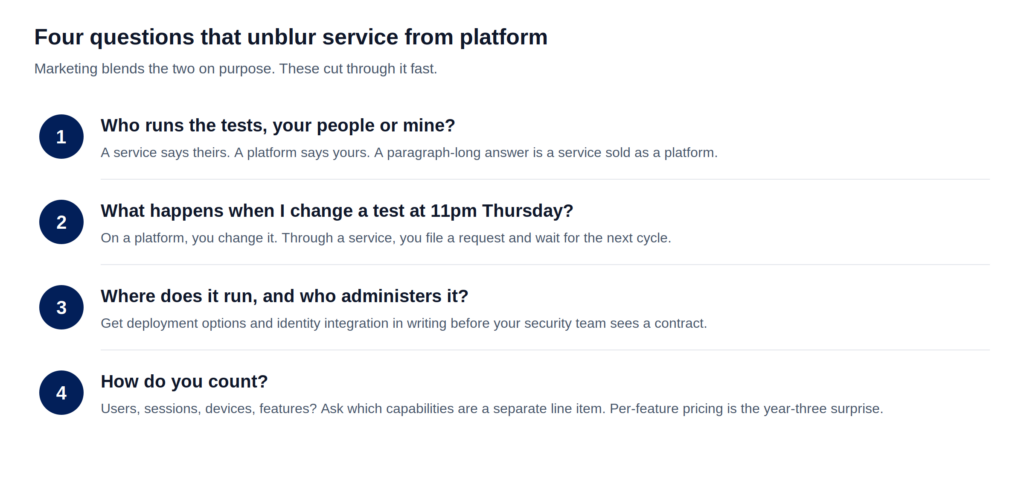
That question has to be put to a vendor out loud, and marketing is built to stop you answering it. The service-versus-platform line gets blurred deliberately, because the same page has to sell to both buyers. Four questions unblur it fast.
- Who runs the tests, your people or mine? A service says theirs. A platform says yours. Anything that takes a paragraph to answer is a service being sold as a platform.
- What happens when I want to change a test at 11pm on a Thursday? On a platform you change it. Through a service you file a request and wait for the next cycle. This single question predicts more post-purchase friction than any feature comparison.
- Where does it run, and who administers it? Get the deployment options and the identity integration in writing before your security team sees a contract, not after.
- How do you count? Users, concurrent sessions, devices, features, or some combination. Ask which capabilities sit behind a separate line item, because per-feature licensing is where a headline rate becomes a year-three surprise.
Push hardest on the fourth. Ask for the full price list, not a quote, and ask which line items are required to do the thing you just watched in the demo.
You will also need someone else to sign off, and they do not care about any of the above.
Your champion evaluates capability. Your economic buyer funds an outcome, and the case has to be translated for them. The translation is not hard, but it has to be explicit. Price the escaped defect in support load and reputation. Price an extra week of release time as delayed revenue. Then name your risk exposure on the platforms where your customers actually are. A mobile app testing services company that can only be justified on features will lose its funding review to something that was justified on money.
Which brings the decision back to where it started. You were never really choosing between ten names on a list. You were deciding which of three options fits the team you have and the team you will have in a year: a service that owns the testing, a platform your engineers own, or a platform a partner runs for you while you build the practice behind it. Settle that, and the shortlist mostly writes itself, because most of what you were about to evaluate stops being a candidate.
If you want a structured read on which option fits you, Kobiton’s Mobile Maturity Assessment walks through where your testing practice is today and what the next step looks like. It is our tool, so treat it as a starting point, not an independent audit.
Mobile app testing companies: frequently asked questions
What kinds of companies handle mobile app testing?
They fall into three groups rather than one ranking: QA services firms that test on your behalf, platform vendors that provide real-device infrastructure your team tests on, and systems integrators who deliver a platform as part of a wider engagement. Which group you need depends on whether you have QA staff.
What is the difference between a mobile app testing company and a testing platform?
A company sells you an outcome. Their testers run your test plan and hand back defects. A platform sells you capability. Your engineers get real devices, parallel execution, and CI integration, and they keep ownership of the tests. Different cost shapes, different staffing assumptions.
Should we outsource mobile app testing or build QA in-house?
Outsource when you have no QA function and no funded plan to build one. Build in-house when testing is continuous rather than periodic and your release cadence is faster than a service’s cycle. Many enterprises do both: a platform they own, staffed initially by a partner.
What should we ask a mobile app testing company before signing?
Who writes and runs the tests, where the infrastructure is deployed and who administers it, how licensing counts users and features, and what the full price list looks like rather than a single quote. Ask about deployment on the first call, because it disqualifies vendors late.
How long does it take to choose and onboard one?
In a regulated enterprise, plan for two to four months from RFP to decision, plus onboarding for any vendor not already on your approved list. NDA and vendor-onboarding steps add weeks before the RFP goes out, so the total is longer than the RFP window suggests.
How much does it cost to hire a mobile app testing company?
It depends on which kind you hire. A service charges by project, retainer, or tester time. A platform charges by subscription or pay as you go, based on concurrency, users, or device minutes. A partner engagement is a platform license plus delivery fees. Ask every vendor to price the same scope, then ask for the price list behind the quote.
What certifications should a mobile app testing company have?
Ask for a SOC 2 Type II report or an ISO 27001 certificate, and ask your security team whether it needs both. SOC 2 is an auditor’s report, not a certificate, so ask for the current report, not the badge. HIPAA has no official certification, so get a Business Associate Agreement if the vendor will handle protected health information for you. For GDPR, get a data processing agreement. PCI DSS can apply if the test environment touches real card data or can affect the systems that handle it.
Why do real devices matter when choosing a testing company?
Emulators and simulators cannot reproduce OEM firmware, real battery, thermal and memory behavior, biometrics, camera, or real network variability. A company whose coverage is mostly virtual cannot prove the flows that decide whether you ship, so real-device depth, across the deployment model you need, is the first thing to verify.
Which mobile app testing company is best for complex iOS flows?
Look for real iOS device access across multiple iOS versions and screen sizes, not simulator-only coverage, plus XCUITest and Appium support and documented experience with flows like biometrics, deep links, and permissions. Verify it on real devices in a pilot rather than taking the claim from a feature list.
