Jun 22, 2026
Will AI Replace Mobile Testers? An Honest Answer for QA
David Hand
Read More
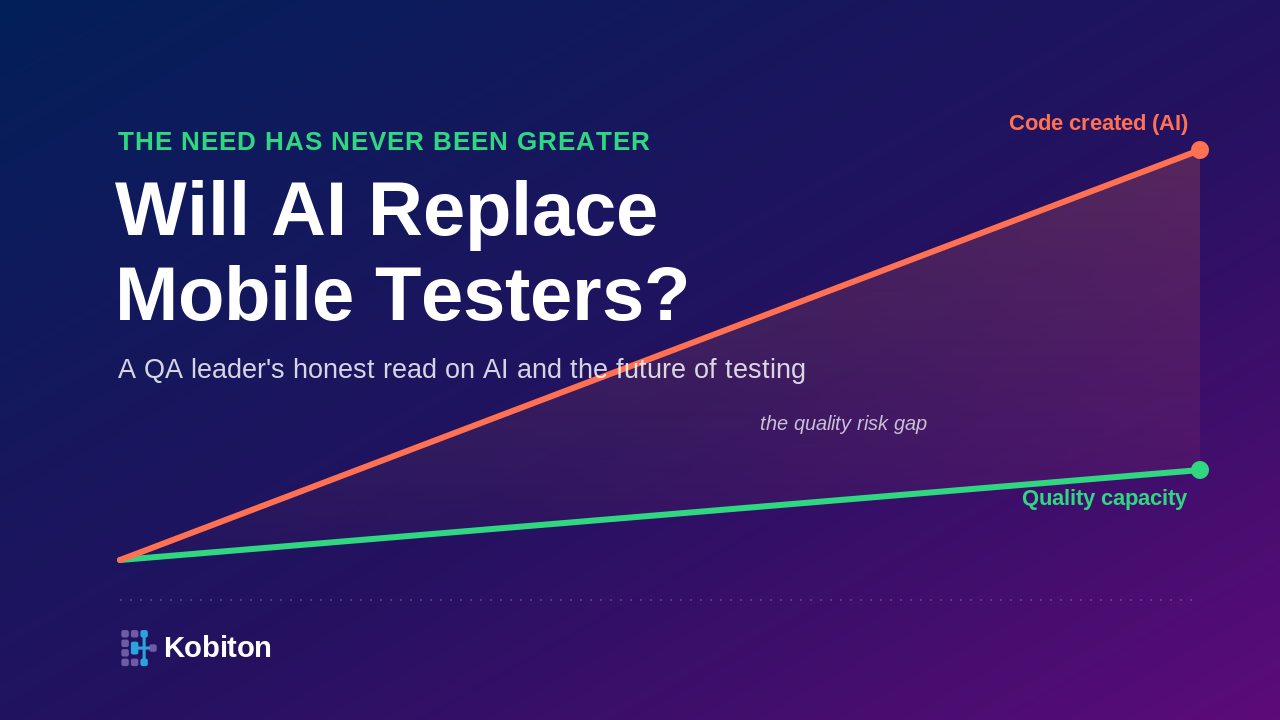
Leading a team through AI powered mobile testing is a management problem before it is a tooling one. The signal that this shift is real did not come from a vendor. An Anthropic lead who runs its Claude Code team recently said coding is no longer the bottleneck, and pointed to engineers shipping on the order of eight times more code per quarter than a year ago. When creation gets that cheap, verification becomes the scarce resource, and the people who do verification are your testers.
This is not just one lab’s experience. The 2025 DORA report, based on nearly 5,000 practitioners, found that AI now lifts delivery throughput but still drags on stability, because faster change exposes weak testing downstream, and that 30% of developers place little or no trust in AI-generated code.
In the previous post I argued that AI raises the need for testing rather than removing it, and that the manual-only regression workflow is the part actually at risk. That post ended on one underdeveloped instruction: reskill on purpose. This is the part I left as a single bullet.
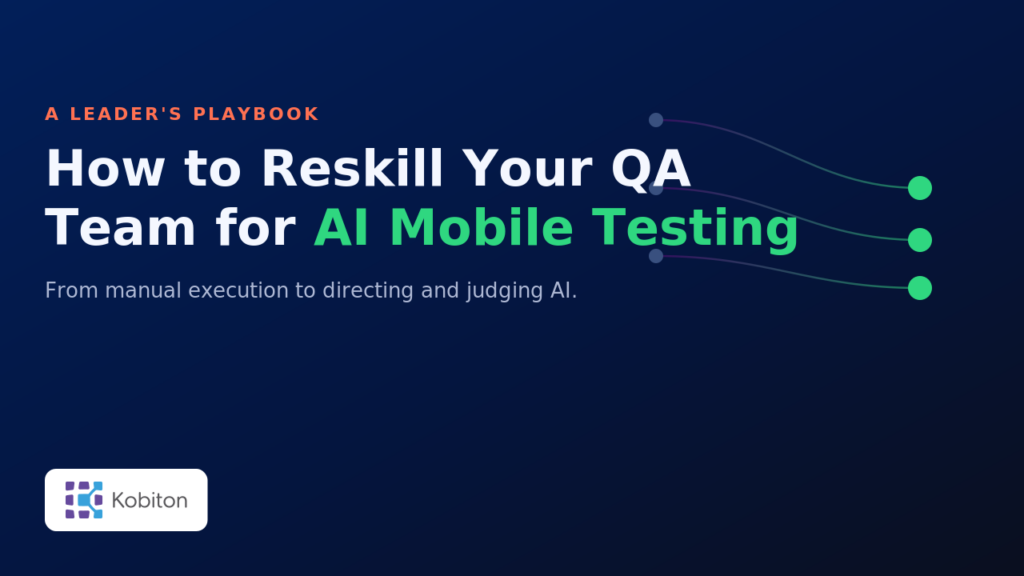
Reskilling is not a budget you approve once and forget. It is a quarter-by-quarter program you run, and most teams do it by accident, which is the same as not doing it. What follows is the playbook: a skills map, a 30/60/90 day plan, a pairing mechanic, the metrics that prove it worked, and the honest part about the people who do not make the jump.
Before you book a single course or buy a single seat, write down two columns: the competencies your team has today and the competencies AI mobile app testing actually requires. The destination was the easy part to name. The map from here to there is what most leaders skip, and you cannot reskill toward a target you have not written down.
If it helps to know the gap is industry-wide, the World Quality Report 2025-26 found that half of organizations still say they lack the AI and machine-learning expertise their quality engineering now needs.
Here is the version I would start from and adjust per team.
| Current-state competency | Target-state competency |
|---|---|
| Manual regression execution | Risk-based test design (deciding what to test hardest) |
| Hand-coded script writing | AI-tooling and prompt fluency (directing AI to generate and adapt tests) |
| Script maintenance and locator patching | Reviewing and supervising AI-generated tests |
| Defect logging and reproduction | Exploratory testing technique (finding what no case covers) |
| Executing someone else’s test plan | Owning the quality signal the business trusts to ship |
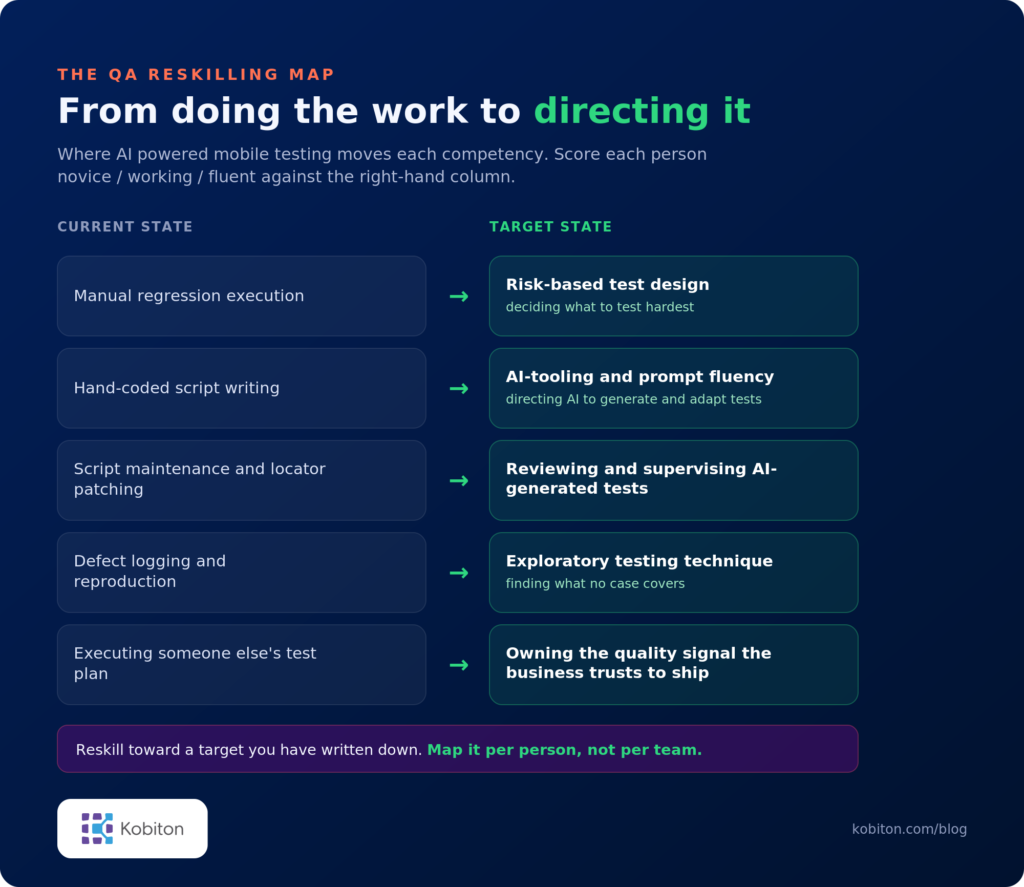
Two things matter about this table. First, it is per person, not per team. A QA leader at a US brokerage described his honest baseline to me in plain terms: most of the team knew automation, but some were still struggling, with manual testing happening alongside. That is the normal starting condition. A single team holds people at very different points on the map, and a one-size program serves none of them.
Second, notice that not one target competency is “learn to code.” The shift is from doing the mechanical work to directing and judging it. That distinction is the whole game, and it is where most reskilling efforts quietly go wrong.
To make the baseline real rather than a gut feel, score each person against each target competency on a simple three-point scale: novice (cannot do it yet), working (can do it with support), and fluent (can do it alone and teach it). The exercise takes an afternoon and gives you a grid that tells you exactly who pairs with whom and where your single points of failure sit. If only one person on a team of six is fluent at exploratory testing, that is a risk on a spreadsheet, not a vague worry.
The fastest way to lose your strongest manual testers is to let “reskill” come to mean “become a developer.” That framing turns a motivated tester into a junior programmer competing with people who have coded for a decade, and it is a competition they did not sign up for and will not win.
This barrier is concrete, not abstract. A practitioner at a global payments company described it cleanly: learning JavaScript or Python is a steep curve for people who test for a living. He added that the hardest part of getting started with a framework like Appium is often just standing up the local environment, before a single useful test exists. Multiply that friction across a team and you get quiet opt-out, not adoption.
Even where coding is genuinely part of the plan, the learning curve is real and you should plan for it rather than wish it away. A QA lead at a North American telecom compared picking up the platform’s scripting to learning any other test tool, a real investment of weeks, not an afternoon. Treat that curve as a scheduled cost with protected time, and it becomes manageable. Pretend it does not exist, and it shows up later as a stalled rollout and a frustrated team.
So the strategic decision sits with you, not with the individual tester. If the only path up your skills map runs through a coding bootcamp and a brittle setup, the program stalls. Choose target skills and tooling that let a strong tester direct AI in mobile testing rather than fight it. Lower the barrier deliberately. The win is a domain expert pointing AI at the right risks, not a tester forced to out-code the developers.
You do not need a five-year transformation. You need ninety days that build momentum and a number you can show the people who sign budgets.
Separate the hours your team spends on script maintenance and repetitive regression from the hours spent on strategy and exploration. Most leaders are surprised by the ratio, and that ratio is your business case. At the same time, baseline each person against the skills map so you know who sits where. Then pick the pilot: aim AI at script maintenance first. It is the highest-pain, lowest-risk entry point because you are attacking the work everyone already hates, not the work people are proud of.
Pair your people deliberately (the next section covers how), set explicit per-person learning goals, and run the maintenance pilot for real. Start capturing one baseline metric now so you can prove movement later. Resist the urge to boil the ocean. One workflow, done well, with a measurable result.
Move from the pilot to a second workflow, write the new role definitions down, and shift your reporting from activity to outcomes. The point of day 90 is not completion. It is a repeatable loop and visible proof.
Two patterns from teams that did this well are worth copying. A major quick-service restaurant chain ran its rollout with separate tracks for manual testers, developers, and admins, and framed the whole thing as planning the next six months and then learning where the next gap was. Role-tracked and phased beat big-bang. A North American cable operator set a standing biweekly training cadence after go-live, which is the right instinct. Reskilling is a cadence, not a one-day event.
Self-assessment
Rate your team on each target competency. Novice = cannot do it yet. Working = can do it with support. Fluent = can do it alone and teach it.
Rate all five competencies to see your team’s readiness and recommended next move.
I warned in the last post not to assume skills spread by osmosis. They do not. A lunch-and-learn with no follow-through produces a pleasant hour and zero durable capability. Here is the mechanic that works instead.
Pair an automation-fluent or AI-fluent person with a domain-deep manual tester, and give the pairing four things:
A real goal reads like this: "By week four, you independently review and approve the AI-generated regression suite for the checkout flow and flag at least two coverage gaps." That is testable. "Get more comfortable with AI" is not.
Pairing works because it runs both directions. The domain-deep tester teaches product risk and the messy reality of real user journeys. The AI-fluent partner teaches the tooling. Neither one is the junior, and naming it that way protects the dignity of your most experienced people while they learn.
Extend the activity-to-outcome shift to your people, not just your tooling. "Hours of training delivered" is an activity number and it tells you nothing about whether anyone got better.
Track three layers instead:
Split those into leading and lagging indicators so you are not flying blind for a quarter. Competencies moving from novice to working, and maintenance hours dropping, are leading indicators you can read inside the first month. Escaped defects and release confidence are lagging indicators that confirm the program weeks later. If your leading indicators are flat at day 30, fix the program before you wait on the lagging ones to deliver bad news.
The maintenance-share metric does double duty. A consumer fintech I worked with ran roughly seven automation engineers against more than twenty manual testers. When AI absorbs the maintenance load that a ratio like that generates, the reclaimed hours are both the budget that funds the reskilling and the proof it is working. Once the team's contribution shows up in outcome numbers, reskilling stops reading as a cost line and starts reading as the thing protecting how fast you can ship.
I said last time that the manual-only workflow is genuinely exposed. A real playbook has to deal with the person attached to that workflow, not just the workflow itself.
Be direct and humane about it. Most people move up the skills map when you give them a true path, protected time, and tooling that does not demand they become a coder. That is the majority, and they are worth the investment. Some will not move, and pretending everyone will helps no one, least of all them.
What I would not do is default to replacement. Consider how these teams are often structured. A multinational construction-materials manufacturer ran a completely separate automation team and manual testing team, as two distinct groups. That split is exactly the wall reskilling has to take down, and it is also where resistance tends to concentrate. The people on the manual side usually hold deep product and domain knowledge that took years to build and that AI cannot reproduce. Reskilling a domain expert is almost always a higher-return move than backfilling one. It just has to come with honest conversations and clear expectations, not vague reassurance.
Everything above rests on a single decision, and it is yours: does your tooling raise a tester's leverage, or does it bolt a chatbot onto the same brittle workflow? Get that wrong and the best skills map in the world has nowhere to land.
When you compare the top mobile testing platforms with AI capabilities, score them on one question. Can a non-coding domain expert direct the platform to run on real devices, detect issues, explain root cause, and move toward validating a fix on real runtime? That capability is the substrate that makes your skills map achievable, because it is what lets judgment, not syntax, become the scarce skill you are hiring and training for. Plenty of AI mobile testing tools now print "AI" on the box without changing that equation, so test the claim against your own workflow before you buy.
This is the gap Kobiton is built to close, and it is the reason the buying decision and the reskilling decision are one and the same. The teams that win the next two years (2026 into 2028) will reskill on purpose and equip their people with tooling that makes reskilling possible. The need has never been greater. The plan is now in your hands.