Mobile banking apps have evolved far beyond simple transaction tools. Today, they function as real-time financial platforms where users expect instant payments, strong security, and a smooth experience at every step. Even a small delay or issue can impact trust.
This is where AI-driven testing plays an important role. It helps teams validate and improve mobile banking experiences at scale while keeping up with constant updates and rising user expectations.
AI is changing how QA teams approach testing. Instead of relying only on static automation, teams can now use intelligent and adaptive methods that learn from real data and continuously improve over time.
Why AI Matters in Mobile Banking Experiences
Mobile banking environments are naturally complex. Teams have to deal with:
- Real-time transactions and instant payments
- Strict security and compliance requirements
- A wide range of devices and operating systems
- Frequent feature updates and releases
Handling all of this manually or with basic automation often leads to gaps in coverage and slower testing cycles.
AI helps solve these challenges by bringing data-driven decision-making into testing workflows. It allows teams to analyze real user behavior, identify risk areas, and focus testing efforts where they matter most.
Banks are already using AI to process transactions, detect fraud patterns, and automate customer interactions. Extending AI into testing is a logical next step to support these systems effectively.
Where AI Fits in Mobile Banking Testing
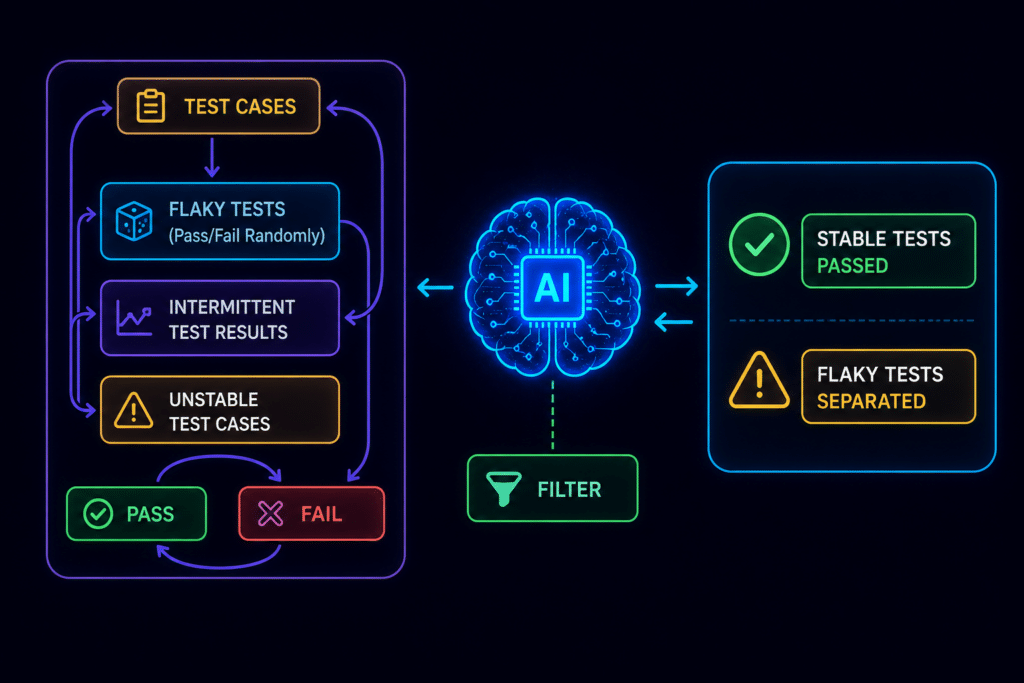
AI improves several key areas of testing:
- Expanding test coverage across devices and user journeys
- Increasing defect detection accuracy
- Validating performance under real-world conditions
- Supporting continuous testing within CI CD pipelines
Instead of manually writing and maintaining large numbers of test scripts, AI models analyze how the app behaves, how users interact with it, and what issues have occurred in the past. Based on this, they adjust test execution in a more efficient way.
Core Use Cases of AI in Testing Mobile Banking Experiences
1. Intelligent Test Case Generation
AI can analyze:
- User behavior patterns
- Transaction flows
- Historical defects
Using this data, it automatically creates test cases for:
- Payments and fund transfers
- Login and authentication flows
- Edge case financial scenarios
This reduces reliance on manual scripting and improves coverage of critical user journeys that might otherwise be missed.
2. Self-Healing Test Automation
Mobile banking apps are updated frequently, especially the user interface. Traditional automation often breaks when UI elements change.
AI addresses this by:
- Identifying dynamic locators
- Updating scripts automatically
- Reducing maintenance effort
This is particularly useful for dashboards, transaction lists, and onboarding flows where UI changes are common.
3. AI-Powered Fraud and Risk Scenario Testing
AI can simulate complex scenarios such as:
- Suspicious transaction patterns
- Device spoofing behavior
- Unusual session activity
Since banks already rely on AI to detect anomalies in real time, testing teams can use similar models to validate:
- Fraud detection systems
- Risk scoring models
- Security workflows
This makes testing more aligned with real-world threats.
4. Performance Testing with Predictive Insights
Performance is critical in mobile banking. Users expect near instant responses, especially for payments and balance updates.
AI improves performance testing by:
- Predicting traffic spikes, such as salary days or promotions
- Simulating realistic user loads
- Identifying latency issues early
This allows teams to fix performance problems before they affect users.
5. Visual Testing and UI Anomaly Detection
AI-based visual testing tools help maintain consistency across devices by:
- Detecting UI inconsistencies
- Identifying broken layouts
- Validating responsive design
This is essential for delivering consistent mobile banking experiences across different screen sizes, operating systems, and device configurations.
6. Conversational AI Testing
Many banking apps use chatbots, voice assistants, and in app support systems.
AI testing helps validate:
- Intent recognition accuracy
- Response consistency
- Multi-language support
- Escalation to human agents
Since these systems handle a large volume of user queries, accuracy directly impacts customer satisfaction.
7. Personalized Experience Validation
Modern banking apps personalize features such as:
- Spending insights
- Product recommendations
- Alerts and notifications
AI testing ensures that:
- Personalization logic works correctly
- Recommendations are accurate
- Users are not misclassified or targeted incorrectly
This is important because personalization strongly influences engagement and user trust.
8. Continuous Testing in CI CD Pipelines
AI integrates into CI CD workflows to make testing faster and more focused.
It helps by:
- Prioritizing high-risk test cases
- Reducing execution time
- Optimizing regression testing
Instead of running every test, AI selects the most relevant ones based on code changes, user impact, and risk areas.
Key Benefits of AI in Mobile Banking Testing
Faster Release Cycles
AI reduces manual effort and allows teams to release updates more quickly while maintaining quality.
Improved Accuracy and Defect Detection
AI identifies patterns and anomalies that traditional testing may miss, leading to better defect detection.
Reduced Testing Costs
Automating repetitive tasks lowers operational costs and reduces the need for large manual testing efforts.
Stronger Security Validation
AI helps simulate realistic threat scenarios and supports better validation of fraud detection systems.
Scalable Testing Across Devices
Teams can test across a wide range of real devices and configurations without increasing manual workload.
Better User Experience
AI supports smooth, fast, and reliable app performance, which is essential for retaining users in mobile banking.
Challenges to Consider
Despite its advantages, AI testing also comes with challenges:
- Data quality can affect model accuracy
- Bias in AI models can impact results
- Integration with legacy systems can be complex
- Regulatory and compliance requirements must be met
In financial environments, AI systems must remain transparent and auditable.
Best Practices for Implementing AI in Testing
- Start with high-impact areas such as fraud detection, payments, and login flows
- Use real device testing environments like Kobiton
- Combine AI with human validation for sensitive scenarios
- Continuously train models using real production data
- Align testing processes with compliance standards such as PCI DSS and GDPR
How Kobiton Supports AI-Driven Mobile Banking Testing
Kobiton helps teams run advanced testing workflows on real devices, which is essential for mobile banking apps.
With Kobiton, teams can:
- Run AI-driven automation on real devices
- Capture real user interactions to improve test creation
- Test performance under real-world conditions
- Integrate testing into CI/CD pipelines
Using Kobiton allows QA teams to validate mobile banking experiences with greater accuracy while keeping testing efficient and aligned with real user conditions.
Final Thoughts
AI is changing how mobile banking apps are tested. It moves testing from a reactive process to a predictive one, allowing teams to identify issues before users experience them.
For modern banking apps, success depends on speed, security, and a smooth user experience.
AI-driven testing provides the foundation needed to meet these expectations at scale while keeping up with the pace of innovation.