What are the Key Benefits of Scriptless Testing over Traditional Script-Based Automation
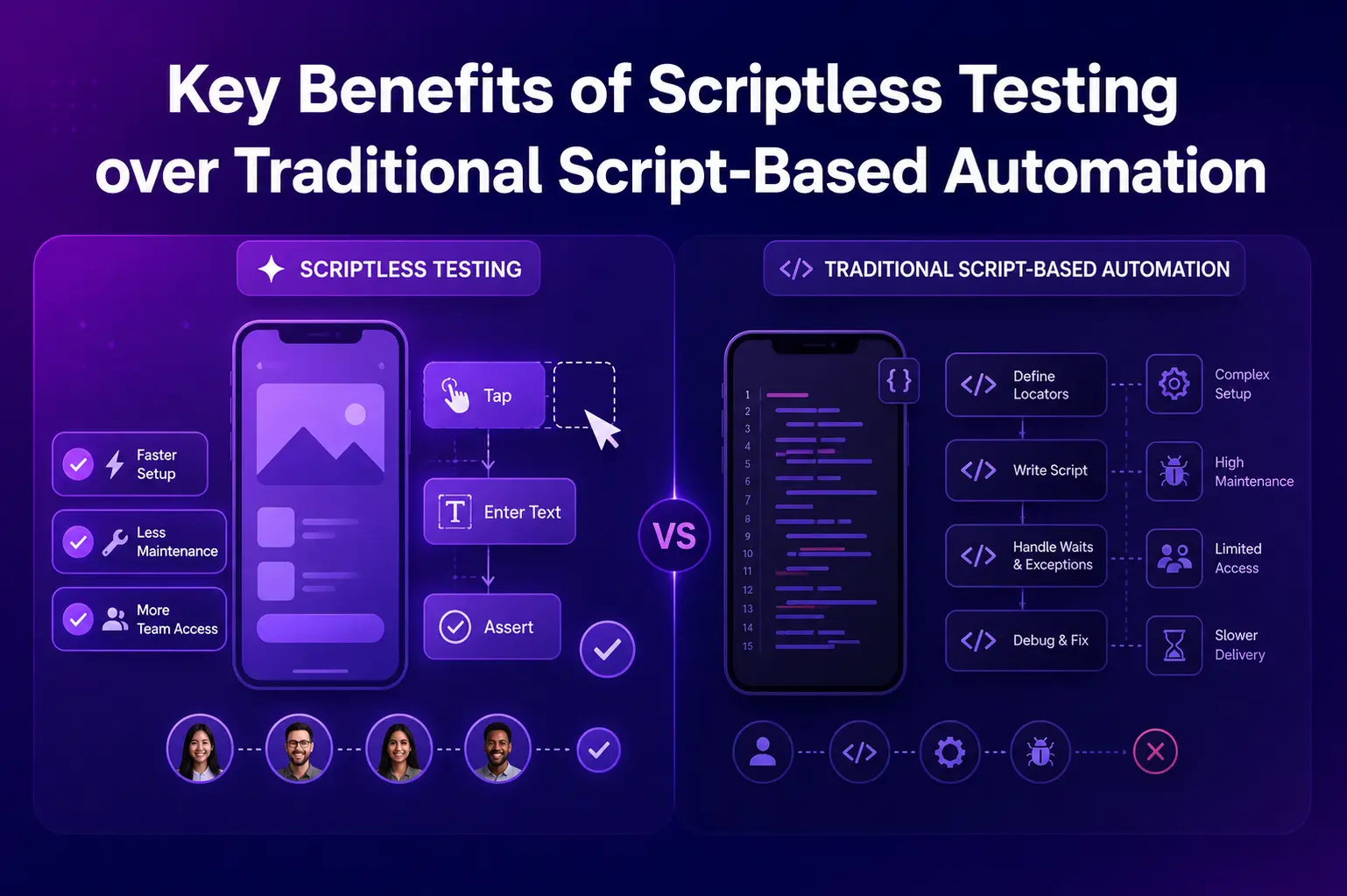
The world of software testing is evolving rapidly, and one of the most talked-about advancements is Scriptless Testing. Businesses today want faster releases, improved quality, and reduced costs all without the steep learning curve of writing and maintaining complex scripts. That’s where scriptless approaches come in.
In this blog, we’ll explore the benefits of scriptless testing compared to traditional script-based automation, highlight the role of scriptless testing tools, and explain why modern teams are making the shift.
The Challenges of Script-Based Testing
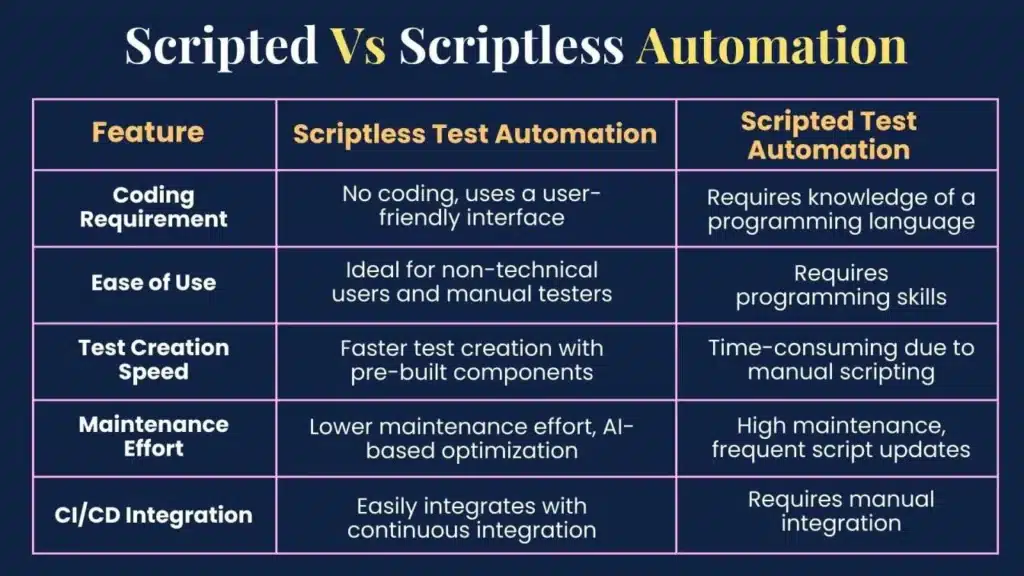
Before diving into the advantages of scriptless automation, it’s important to understand the challenges of script-based testing.
- Steep Learning Curve – Writing automation scripts requires knowledge of programming languages like Java, Python, or C#, which excludes non-technical team members.
- High Maintenance – Test scripts often break when there are UI or functionality changes, requiring constant updates.
- Slow Turnaround – Building large test suites can take weeks, slowing down Agile and DevOps pipelines.
- Limited Collaboration – Since only skilled engineers can write and maintain scripts, collaboration with business teams or manual testers is limited.
These challenges set the stage for scriptless testing to emerge as a game-changing solution.
What Script-Based Automation Still Does Well
Those challenges are real, but they are the price of something valuable, and pretending otherwise weakens the case for scriptless testing rather than strengthening it. Script-based automation buys you control.
- Full language power. Conditional logic, loops, shared page objects, and data-driven runs across hundreds of input combinations are all straightforward when a test is a program.
- A mature, portable skill set. Appium and Selenium both build on the W3C WebDriver protocol, so the tooling and the expertise transfer between projects and employers.
- First-class version control and CI. Tests live in the repository alongside the application, get reviewed in pull requests, and run in the pipeline like any other code.
- Complete transparency. When a test fails, an engineer can read exactly what it did. Nothing is hidden behind a tool’s interface.
That control is why coded suites are not going away. The cost is people and time: engineers to write the tests, engineers to review them, and an edit to the code every time a UI change breaks a locator. Manual testers who know the product best often cannot contribute at all.
How Scriptless Testing Actually Works
There are three ways to author a scriptless test, and most platforms offer more than one:
- Record and playback. A tester performs the journey on a real device or browser, and the tool captures each tap, swipe, and entry as an editable step.
- Visual or keyword composition. The tester assembles a test from a library of pre-built actions and validations, arranging and configuring them rather than recording.
- Natural language authoring. The tester describes the flow in plain English and the engine converts the description into runnable steps.
Whichever style you use, what happens next is the same:
1. Author the flow — record it, compose it, or describe it.
2. Add validations. This is the step teams skip and regret. A flow with no assertions proves only that the screens opened.
3. Parameterize the data. Point the test at a data table so one flow covers valid inputs, invalid inputs, and edge cases instead of a single happy path.
4. Run it in parallel across devices and OS versions rather than one at a time.
5. Read the results — screenshots, logs, and video per step, so a failure can be diagnosed without reproducing it locally.
6. Update what changed. Edit the affected step in the visual editor; self-healing absorbs the routine locator changes before they reach you.
You will see scriptless, codeless, no-code and low-code used as if they were the same thing. They overlap heavily, but the distinctions are worth a sentence each, because vendors choose between them deliberately.
| Term | What it usually signals |
| Scriptless / codeless | Tests are created without writing test scripts. Most platforms still allow a custom code block for edge cases, so “no code at all” is rarely literal. |
| No-code | The stronger claim: plain-English steps or visual workflows for everything, aimed squarely at manual testers and business users. |
| Low-code | Visual authoring with scripting deliberately left available, for mixed teams where engineers extend what testers create. |
This article uses scriptless throughout. The distinction matters most when you are comparing tools rather than approaches.
Key Benefits of Scriptless Testing
1. Faster Test Creation and Execution
One of the biggest benefits of scriptless testing is speed. Instead of writing lengthy scripts, testers can create cases using drag-and-drop workflows, record-and-playback features, or visual interfaces. This accelerates test design and allows organizations to keep pace with frequent product releases.
2. Accessibility for Non-Technical Users
Traditional automation often leaves manual testers or business analysts on the sidelines. With business user test automation, scriptless platforms empower non-coders to create and run tests. This improves collaboration between QA teams, product owners, and developers, ensuring test coverage is broad and business logic is fully validated.
3. Reduced Maintenance Effort
Unlike fragile script-based frameworks, scriptless testing tools often include AI-driven self-healing, visual updates, and reusable test components. When the app changes for example, a button is moved the tool automatically adapts. This drastically lowers maintenance overhead and improves efficiency.
It is worth being precise about what self-healing does. When an element’s identifier changes, the tool recognizes the failure and re-matches the element instead of breaking the run. That is the routine case, and it accounts for most of the churn in a mobile suite. What it does not do is replace human judgment about genuine functional changes: a new step in a flow, a changed business rule, or a redesigned screen still needs a person. Self-healing cuts the maintenance noise so your engineers spend their time on the real changes.
4. Cost Savings and Higher ROI
By reducing the reliance on highly technical testers, organizations cut down training and hiring costs. Scriptless mobile automation further enhances ROI by allowing teams to test across multiple devices and platforms without specialized expertise. Faster cycles mean quicker releases, which directly impacts profitability.
5. Improved Scalability
Modern applications must work seamlessly across iOS, Android, and multiple OS versions. Script-based testing often struggles to scale due to complex setups. Scriptless solutions make it easy to run parallel tests on real devices, ensuring broad coverage without bottlenecks.
6. Better Collaboration and Transparency
Scriptless automation offers visual test flows that anyone on the team can understand. This means business stakeholders can review, validate, and even contribute to test cases. Transparency reduces miscommunication and ensures critical user journeys are always tested.
Scriptless vs Script-Based Automation: Head to Head
The two approaches produce the same thing — an automated test that runs without a human driving it. What differs is who can build it, how fast, and what happens when the app changes.
| Dimension | Scriptless testing | Script-based automation |
| Who can author | Any tester, including manual testers and business analysts | Engineers who know Java, Python, C#, or JavaScript |
| Time to first test | Hours — record a flow and run it | Days to weeks, once framework setup is counted |
| Setup and infrastructure | Minimal; the platform supplies the runner and the devices | Framework, drivers, dependencies and CI wiring built by hand |
| Complex logic and branching | Limited and tool-dependent; most platforms allow a custom code block for the edge cases | Full language power — conditionals, loops, shared utilities, data-driven runs |
| Maintenance when the UI changes | Low where self-healing re-matches the element; steps are edited visually | Manual locator upkeep in code for every change |
| Readability | Steps read as the user journeys they represent, so anyone on the team can follow them | Readable only by people who read code |
| Version control and CI/CD | Varies by tool, and strongest where the platform generates real script files | First-class — tests live in the repo like any other code |
| Best fit | Smoke tests, happy-path regression, broad functional coverage across devices | Complex, data-driven, edge-case suites and anything needing custom logic |
Why Scriptless Mobile Automation Matters
With mobile-first strategies dominating today’s digital landscape, scriptless mobile automation has become essential. Testing across countless devices, screen sizes, and operating systems requires a scalable approach. Scriptless tools simplify this by:
- Recording user actions (taps, swipes, and inputs) directly on devices
- Converting interactions into reusable test steps
- Running the same tests across multiple devices simultaneously
- Delivering instant reports with screenshots, logs, and videos
This not only accelerates mobile app testing but also ensures higher accuracy and reliability in production releases.
One thing does not change when you drop the scripts: where the tests run. Emulators and simulators miss the sensor, rendering, and fragmentation failures that only appear on physical hardware, so release-critical runs belong on real devices however the test was authored.
You Don’t Have to Choose: Scriptless That Generates Real Code
Framing this as scriptless “versus” script-based assumes you have to pick one. The strongest platforms remove that assumption by generating a real script from a scriptless session. A tester records a flow with no code, and the tool produces a genuine Appium script underneath it.
The tester authors quickly and owns the test. The engineer inherits real Appium code they can read, extend, and check into version control. Nobody is locked into a proprietary format, and the same test can graduate from a quick scriptless capture to a maintained coded asset without being rewritten.
1. Capture the flow scriptless. A tester records the user journey on a real device, with no code.
2. Generate the script. The platform converts that session into a real Appium script in a standard language.
3. Review and harden. An engineer checks the generated locators, adds assertions or data-driven cases, and commits the test to version control.
4. Let it self-heal. Self-healing keeps the script running through routine UI changes, so maintenance stays low between deliberate updates.
The tester never wrote code, the engineer never started from a blank file, and the result is a versioned asset the whole team can trust. When scriptless generates standard framework code, “scriptless vs script-based” becomes “scriptless then script-based”, which is a better deal than either one alone.
Where Scriptless Testing Still Falls Short
Scriptless tools remove the scripting. They do not remove the test design, and the gap between those two things is where teams get caught out.
- Complex logic still wants code. Deep branching, custom calculations, multi-system workflows, and backend checks are easier to express in a language than in visual steps. Most platforms allow a custom code block for exactly these cases — check that yours does before you need it.
- Recorded tests get noisy. A recorder captures everything, including stray taps, extra navigation, and unstable element references. Recorded flows need a cleanup pass before they join a regression suite.
- Maintenance shrinks but doesn’t vanish. Self-healing handles a moved or renamed element. It does not handle a new step in a flow, a changed business rule, or a redesigned screen.
- Shallow assertions pass for the wrong reasons. A test that only clicks through a journey can go green while the business outcome is wrong. Every flow needs real checks on state, data, and error handling, not just successful navigation.
- Dynamic UIs can still flake. Changing IDs, async loading, personalized content, third-party widgets, and conditional pop-ups are hard for any approach, and scriptless is not immune to them.
- Test data becomes the bottleneck at scale. A handful of data-driven tests is easy. Hundreds need clean fixtures, reset logic, environment-specific values, and user roles — and that work is the same whether or not you wrote the test in code.
- Debugging can be slower for non-coders. Screenshots and video help, but some failures need logs, network detail, or selector information. Judge a tool by how much it shows you when a test fails, not by how little it asks of you when one passes.
None of this is an argument against scriptless testing. It is an argument for choosing a tool that stays honest when things go wrong, and for keeping an engineer close enough to the suite to handle the cases the tool cannot.
When to Choose Scriptless, and When to Write Code
The decision comes down to two questions: who owns the tests, and how much logic they carry.
| Your situation | The approach that fits |
| A manual-heavy team that needs broad coverage fast, on smoke and happy-path flows | Scriptless testing |
| Complex logic, data-driven runs, deep edge cases, or an existing engineering suite to extend | Script-based automation |
| Both, which describes most teams | Let testers author scriptless flows that generate real Appium code, and let engineers maintain and extend the critical paths |
Most teams end up on the third row. The two approaches stop competing for the same budget the moment a scriptless capture can become a coded test instead of being thrown away and rewritten as one.
Popular Scriptless Testing Tools
To achieve these benefits, teams often rely on modern scriptless testing tools such as:
- Kobiton – Mobile-first platform with AI-driven self-healing automation.
- TestGrid – Comprehensive tool for codeless mobile and API testing.
- TestSigma – Cloud-based scriptless framework with CI/CD integration.
- Avo Assure – End-to-end no-code testing across applications.
These platforms empower teams to move beyond the limitations of traditional frameworks like Selenium or Appium, delivering agility and scalability.
What to Look for When You Compare Them
Tools in this category look alike on a feature list and diverge sharply once a suite grows past a few dozen tests. Five things separate them:
- Editable steps. Can a tester reorder, update, or delete one step without re-recording the whole flow? Re-recording is where scriptless suites go to die.
- Validation depth. Look for checks on text, UI state, visual output, and API responses — without dropping into code for each one.
- What the test becomes underneath. Some platforms produce a proprietary artifact; others generate a real Appium or Selenium script you own and can version-control. This is the single biggest difference in whether you can ever leave.
- Reusable components. Shared steps, functions, and reusable flows keep a growing suite manageable. Without them, every new test re-records the login.
- Where tests actually run. For mobile this is decisive: emulators and simulators miss the failures that only appear on physical hardware.
Conclusion
While script-based automation once dominated QA, the benefits of scriptless testing are now too significant to ignore. By addressing the challenges of script-based testing, from high maintenance to slow execution, scriptless approaches unlock faster test cycles, greater accessibility, and stronger collaboration.
With the rise of scriptless mobile automation and user-friendly scriptless testing tools, even business users can participate in automation, bridging the gap between technical and non-technical teams.
For organizations striving for agility, quality, and efficiency, scriptless automation is no longer a luxury it’s a necessity.
FAQs
What is scriptless testing?
Scriptless testing is an automation approach that allows testers to create and run test cases without writing complex code or traditional scripts.
How is scriptless testing different from script-based automation?
Script-based automation requires programming knowledge, while scriptless testing uses visual workflows, drag-and-drop features, and record-and-playback options.
What are the main benefits of scriptless testing?
The main benefits include faster test creation, reduced maintenance, better collaboration, lower costs, improved scalability, and easier access for non-technical users.
Can non-technical users use scriptless testing tools?
Yes. Scriptless testing tools allow manual testers, business analysts, and product teams to create and review tests without needing advanced coding skills.
Why is scriptless mobile automation important?
Scriptless mobile automation helps teams test apps across multiple devices, screen sizes, and operating systems faster, with reusable test steps and instant reports.
Is scriptless testing as reliable as script-based automation?
Modern scriptless tools are far more reliable than early record-and-playback, because AI self-healing repairs a test when an element’s identifier changes. For smoke tests and functional coverage they are dependable. For deep, data-driven, or edge-case logic, script-based automation still gives you more control.
Can scriptless testing produce real Appium code?
Yes, on platforms built for it. Kobiton converts a scriptless or manual session into an executable Appium script, so a no-code capture becomes standard, maintainable code that engineers can extend and keep in version control.
What does self-healing fix, and what still needs a human?
Self-healing repairs a test when an element’s identifier changes, by re-matching the element, so routine UI tweaks no longer break runs. It does not replace human judgment for genuine functional changes: a new step in a flow, a changed business rule, or a redesigned screen still needs a person to update the test.
Can scriptless tools handle API and non-functional testing?
Partly. Many platforms now let you add API steps inside a scriptless test for setup, validation, or cleanup. Performance and security testing usually stay with specialized tools, though your scriptless functional suite can run alongside them.
What is the hardest part of moving to scriptless testing?
Rarely the tool. It is deciding which existing tests to migrate rather than re-recording everything from scratch, and getting experienced automation engineers to see scriptless as their on-ramp rather than a threat to their work.