What are the Key Benefits of Scriptless Testing over Traditional Script-Based Automation
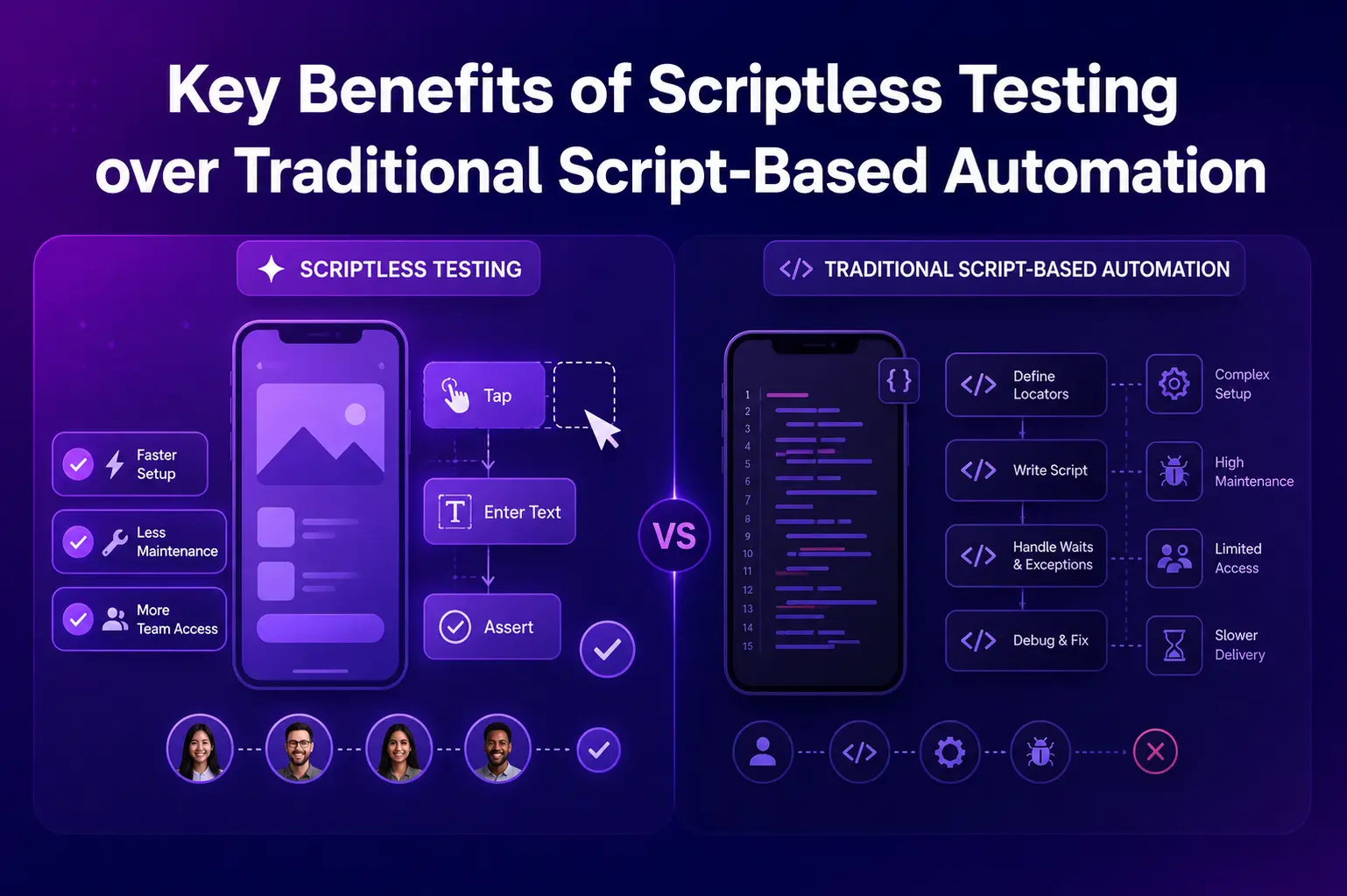
The world of software testing is evolving rapidly, and one of the most talked-about advancements is Scriptless Testing. Businesses today want faster releases, improved quality, and reduced costs all without the steep learning curve of writing and maintaining complex scripts. That’s where scriptless approaches come in.
In this blog, we’ll explore the benefits of scriptless testing compared to traditional script-based automation, highlight the role of scriptless testing tools, and explain why modern teams are making the shift.
The Challenges of Script-Based Testing
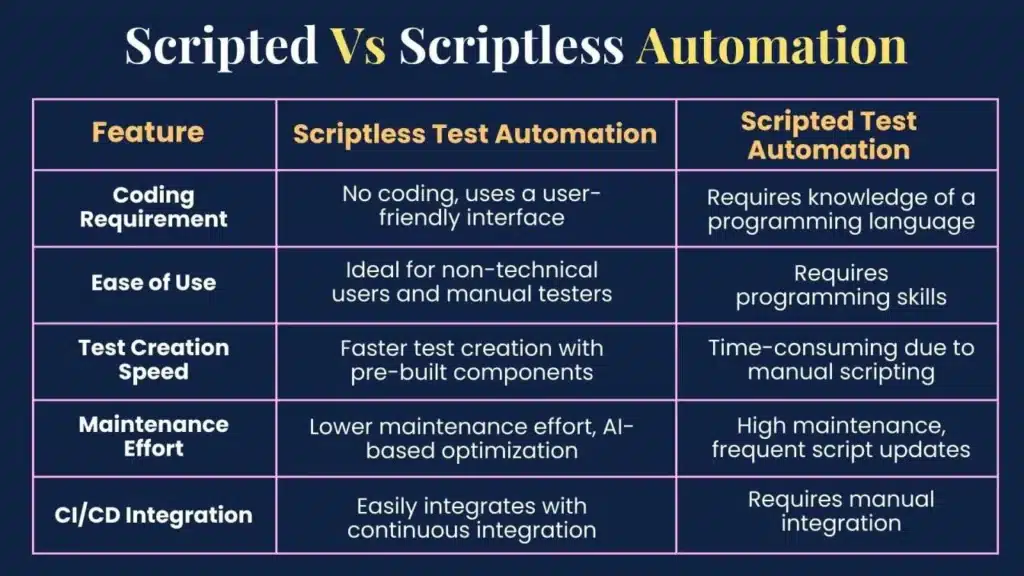
Before diving into the advantages of scriptless automation, it’s important to understand the challenges of script-based testing.
- Steep Learning Curve – Writing automation scripts requires knowledge of programming languages like Java, Python, or C#, which excludes non-technical team members.
- High Maintenance – Test scripts often break when there are UI or functionality changes, requiring constant updates.
- Slow Turnaround – Building large test suites can take weeks, slowing down Agile and DevOps pipelines.
- Limited Collaboration – Since only skilled engineers can write and maintain scripts, collaboration with business teams or manual testers is limited.
These challenges set the stage for scriptless testing to emerge as a game-changing solution.
Key Benefits of Scriptless Testing
1. Faster Test Creation and Execution
One of the biggest benefits of scriptless testing is speed. Instead of writing lengthy scripts, testers can create cases using drag-and-drop workflows, record-and-playback features, or visual interfaces. This accelerates test design and allows organizations to keep pace with frequent product releases.
2. Accessibility for Non-Technical Users
Traditional automation often leaves manual testers or business analysts on the sidelines. With business user test automation, scriptless platforms empower non-coders to create and run tests. This improves collaboration between QA teams, product owners, and developers, ensuring test coverage is broad and business logic is fully validated.
3. Reduced Maintenance Effort
Unlike fragile script-based frameworks, scriptless testing tools often include AI-driven self-healing, visual updates, and reusable test components. When the app changes for example, a button is moved the tool automatically adapts. This drastically lowers maintenance overhead and improves efficiency.
4. Cost Savings and Higher ROI
By reducing the reliance on highly technical testers, organizations cut down training and hiring costs. Scriptless mobile automation further enhances ROI by allowing teams to test across multiple devices and platforms without specialized expertise. Faster cycles mean quicker releases, which directly impacts profitability.
5. Improved Scalability
Modern applications must work seamlessly across iOS, Android, and multiple OS versions. Script-based testing often struggles to scale due to complex setups. Scriptless solutions make it easy to run parallel tests on real devices, ensuring broad coverage without bottlenecks.
6. Better Collaboration and Transparency
Scriptless automation offers visual test flows that anyone on the team can understand. This means business stakeholders can review, validate, and even contribute to test cases. Transparency reduces miscommunication and ensures critical user journeys are always tested.
Why Scriptless Mobile Automation Matters
With mobile-first strategies dominating today’s digital landscape, scriptless mobile automation has become essential. Testing across countless devices, screen sizes, and operating systems requires a scalable approach. Scriptless tools simplify this by:
- Recording user actions (taps, swipes, and inputs) directly on devices
- Converting interactions into reusable test steps
- Running the same tests across multiple devices simultaneously
- Delivering instant reports with screenshots, logs, and videos
This not only accelerates mobile app testing but also ensures higher accuracy and reliability in production releases.
Popular Scriptless Testing Tools
To achieve these benefits, teams often rely on modern scriptless testing tools such as:
- Kobiton – Mobile-first platform with AI-driven self-healing automation.
- TestGrid – Comprehensive tool for codeless mobile and API testing.
- TestSigma – Cloud-based scriptless framework with CI/CD integration.
- Avo Assure – End-to-end no-code testing across applications.
These platforms empower teams to move beyond the limitations of traditional frameworks like Selenium or Appium, delivering agility and scalability.
Conclusion
While script-based automation once dominated QA, the benefits of scriptless testing are now too significant to ignore. By addressing the challenges of script-based testing, from high maintenance to slow execution, scriptless approaches unlock faster test cycles, greater accessibility, and stronger collaboration.
With the rise of scriptless mobile automation and user-friendly scriptless testing tools, even business users can participate in automation, bridging the gap between technical and non-technical teams.
For organizations striving for agility, quality, and efficiency, scriptless automation is no longer a luxury it’s a necessity.
FAQs
What is scriptless testing?
Scriptless testing is an automation approach that allows testers to create and run test cases without writing complex code or traditional scripts.
How is scriptless testing different from script-based automation?
Script-based automation requires programming knowledge, while scriptless testing uses visual workflows, drag-and-drop features, and record-and-playback options.
What are the main benefits of scriptless testing?
The main benefits include faster test creation, reduced maintenance, better collaboration, lower costs, improved scalability, and easier access for non-technical users.
Can non-technical users use scriptless testing tools?
Yes. Scriptless testing tools allow manual testers, business analysts, and product teams to create and review tests without needing advanced coding skills.
Why is scriptless mobile automation important?
Scriptless mobile automation helps teams test apps across multiple devices, screen sizes, and operating systems faster, with reusable test steps and instant reports.