
As mobile applications become more complex, QA teams are under constant pressure to release faster without sacrificing quality. Device fragmentation, frequent OS updates, and the need to support multiple platforms have turned Mobile Test Management into a core function rather than a supporting task.
Scalable QA teams do not rely on ad hoc testing. They build structured systems that support automation, real device validation, and continuous feedback across development pipelines.
This guide outlines practical best practices that help QA teams manage mobile testing at scale while keeping workflows efficient, traceable, and adaptable.
1. Build a Centralized Mobile Test Management System
A fragmented setup slows down progress and creates confusion. Scalable teams rely on a single source of truth for all testing assets.
Key practices include storing test cases, results, and requirements in one platform, linking test cases directly with user stories and defects, maintaining version history, and enabling visibility across QA, development, and product teams.
A centralized system reduces duplication, improves collaboration, and makes it easier to track testing progress across release cycles.
2. Standardize Test Case Design for Reusability
As QA teams grow, inconsistency can quickly become a problem. Standardization helps keep test assets reusable and easier to maintain.
Effective approaches include using clear naming conventions that combine feature, scenario, and expected outcome, breaking test cases into modular steps, and reusing common actions across multiple workflows. Peer reviews before publishing also help maintain quality.
Well structured test cases reduce maintenance effort and make it easier for new team members to get up to speed.
3. Define a Clear Device Strategy for Mobile Coverage
Device fragmentation has a direct impact on testing quality. A structured device strategy prevents gaps caused by random device selection.
Teams should identify the most relevant devices based on user data and maintain balanced coverage across Android and iOS. Android requires broader coverage due to fragmentation, while iOS benefits from performance consistency.
A hybrid mix works best, where real devices are used for accuracy and emulators support faster execution. Platforms like Kobiton make it easier to access a wide range of real devices without maintaining physical labs.
4. Combine Real Devices with Virtual Testing Environments
Scalable QA teams do not rely on a single environment. Each type of testing setup serves a different purpose.
Real devices are essential for validating performance, hardware features such as camera and biometrics, network variability, and full user journeys. Emulators and simulators are useful during early development stages, for running large regression suites, and for CI pipeline execution.
This balance allows teams to maintain speed while still validating real world behavior accurately.
5. Integrate Mobile Test Management into CI Pipelines
Modern QA workflows are continuous. Testing should happen alongside development, not after it.
Best practices include triggering automated tests on every code commit, running smoke tests during pull requests, executing regression suites before releases, and automatically failing builds when critical issues are detected.
When integrated with real device platforms like Kobiton, these workflows provide faster and more reliable feedback across different environments.
6. Prioritize Test Automation Based on Stability
Not every test is suitable for automation. Scalable QA teams focus on stability and long term value.
Automation works best for regression testing, login flows, transactional paths, and API validations. These areas remain consistent across builds and provide strong returns.
On the other hand, highly dynamic UI flows, exploratory testing, and experience driven validation are better handled manually. A balanced approach keeps automation reliable and reduces unnecessary maintenance.
7. Establish Test Data and Environment Control
Uncontrolled environments lead to inconsistent results and unreliable testing outcomes.
Teams should use versioned data sets, reset environments before major runs, isolate environments for parallel execution, and simulate production like conditions wherever possible.
This level of control reduces flaky results and improves confidence in test outcomes.
8. Implement Test Traceability Across Requirements
Traceability connects test cases directly to business and product requirements.
This makes it easier to understand the impact of changes, identify regression risks, and maintain a clear record of what has been validated before release.
It is particularly important in industries such as fintech and healthcare, where accountability and audit trails are required.
9. Manage Flaky Tests Proactively
Flaky tests can quickly reduce trust in automation systems if left unmanaged.
Teams should identify unstable tests early, isolate them, and investigate the root cause, whether it is related to timing, environment, or data issues. Unreliable scripts should be fixed or removed, and flakiness trends should be tracked over time.
Consistent monitoring helps maintain confidence in CI pipelines and prevents false signals during testing.
10. Align Test Management with Real User Behavior
Effective testing goes beyond functional validation. It should reflect how users actually interact with the application.
Important scenarios include multi session usage, network interruptions, background and foreground transitions, and interactions across multiple devices.
Testing based on real user behavior uncovers issues that scripted flows often miss and provides a more accurate view of application performance.
Mobile Test Management Maturity Model
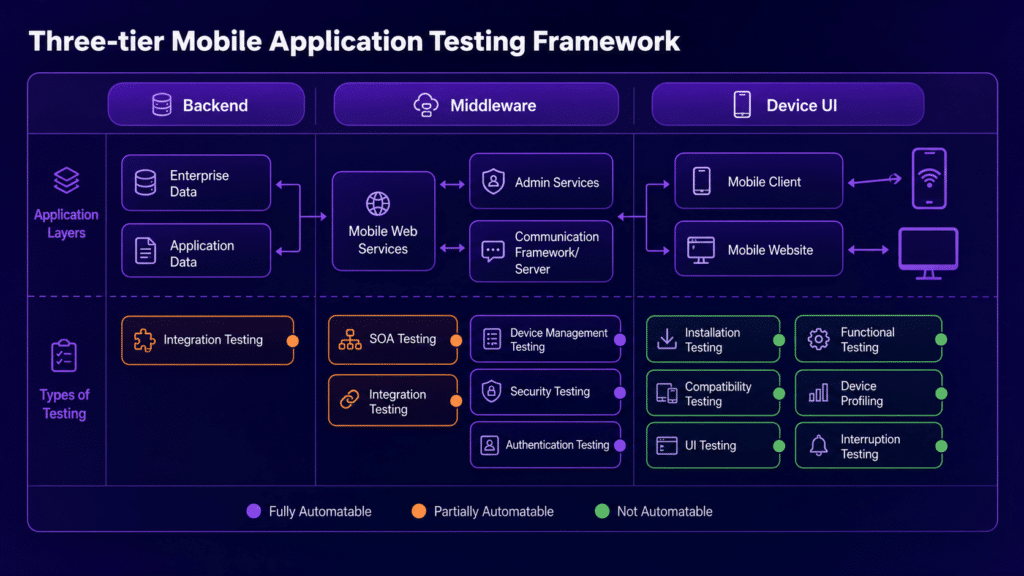
At the basic level, teams rely on manual testing with little structure, which leads to slow releases.
Structured teams introduce centralized repositories and basic automation, improving visibility and consistency.
Integrated teams combine CI workflows, device strategies, and automation to speed up releases.
Scalable teams use parallel execution, real device clouds, and analytics to support continuous delivery with high quality standards.
Common Pitfalls in Mobile Test Management
Many teams face similar challenges, including automating unstable UI flows, overlooking device fragmentation, lacking centralized ownership of test assets, weak integration with CI workflows, and poor control over test data.
Avoiding these issues requires a disciplined and structured approach to testing.
Final Thoughts
Mobile Test Management becomes effective when it moves beyond simple execution and evolves into a connected system that brings together devices, automation, data, and workflows.
For scalable QA teams, success depends on consistency in test design, a clear device strategy, real device validation, continuous integration, and testing that reflects real user behavior.
A well managed testing system improves release speed, strengthens product stability, and delivers a better user experience across all devices and platforms.