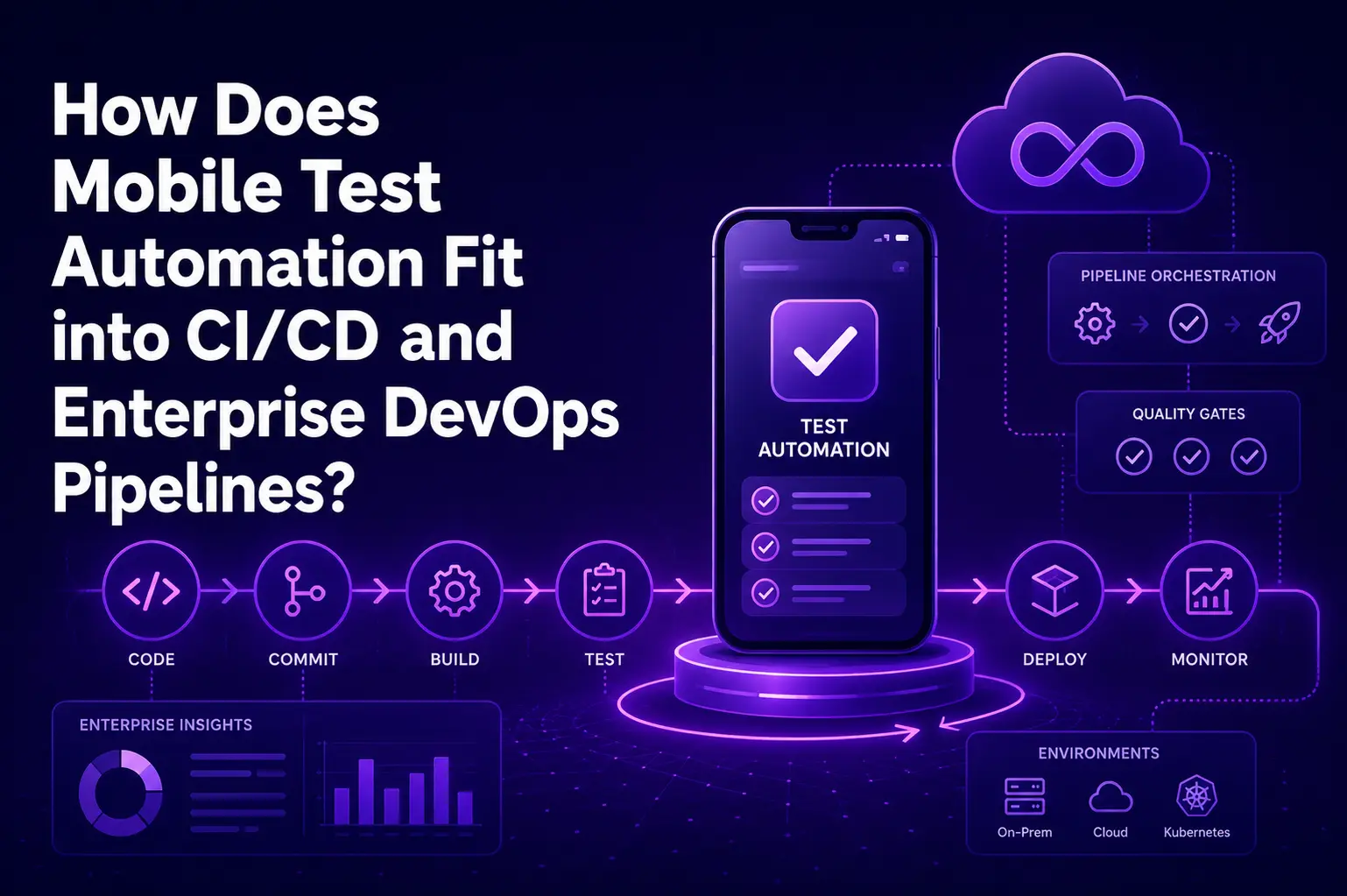
In today’s fast-paced software development world, mobile test automation in CI/CD has become a critical driver for delivering high-quality apps at speed. With continuous updates, a diverse device ecosystem, and user expectations for flawless performance, enterprises can no longer rely solely on manual testing.
Automation is the bridge that connects quality with velocity, especially when integrated into modern DevOps pipelines.
Why Mobile Test Automation Matters in CI/CD
CI/CD (Continuous Integration and Continuous Delivery) is designed to accelerate release cycles. But speed without quality can lead to poor user experiences and costly rollbacks.
Automated mobile app testing tools become indispensable in this context.
Continuous quality checks run automated scripts on every code commit, ensuring defects are caught early.
Scalability across devices is achieved because automation frameworks support parallel testing on iOS and Android, reducing coverage gaps.
Integration with DevOps tools like Jenkins, GitLab, and Azure DevOps allows test suites to run automatically as part of the CI/CD pipeline.
By embedding testing into CI/CD, teams achieve both faster feedback loops and more reliable releases.
Choosing the Right Mobile Automation Testing Tools
Selecting the right tools is central to a successful automation strategy. The market offers both manual mobile testing tools for exploratory and usability testing, and automated mobile app testing tools for regression, performance, and functional testing.
Open-source options like Appium, Espresso, and XCUITest provide flexibility and community support. These frameworks are ideal for teams seeking customizability and cost savings, but they require skilled engineers to maintain.
Enterprise platforms like Kobiton offer real-device cloud access, AI-powered automation, and seamless integration into CI/CD pipelines. Unlike open-source frameworks, these platforms reduce setup complexity and provide built-in scalability.
Many organizations adopt hybrid approaches: using manual mobile testing tools for exploratory checks while relying on automated frameworks for regression and functional testing. This ensures a balance between human insight and machine-driven accuracy.
Mobile Automation Testing Frameworks: iOS and Android
Mobile ecosystems are fragmented, making it important to choose automation frameworks that ensure consistency across iOS and Android.
Espresso (Android) is a native, fast framework integrated with Android Studio.
XCUITest (iOS) is Apple’s native testing framework, stable and optimized for iOS.
Appium (cross-platform) allows teams to automate both iOS and Android apps with a single API.
Platforms like Kobiton enhance these frameworks by providing access to real devices, AI-driven automation, and simplified test management—critical for enterprises operating at scale.
Key Benefits of Embedding Automation into DevOps
Integrating mobile test automation into CI/CD pipelines provides tangible business and technical advantages.
Faster time-to-market: Automated testing reduces cycle time, allowing features to move from code to production faster without sacrificing quality.
Reduced human error: Automated scripts eliminate repetitive manual work and ensure consistent results across builds.
Broader device coverage: Testing across real iOS and Android devices ensures apps behave reliably under real-world conditions.
AI-powered insights: Platforms like Kobiton leverage AI to detect flaky tests, improve stability, and optimize regression suites.
Enterprise-grade scalability: Integrating testing into DevOps pipelines allows teams to manage thousands of test cases across multiple environments.
Best Practices for Success
To maximize ROI from mobile automation, enterprises should prioritize high-value test cases such as login, payments, and navigation.
Balance emulators with real-device testing to validate true user experiences.
Automate regression tests first, then expand to performance and exploratory scenarios.
Use accessibility IDs instead of XPath for stable locators.
Integrate early and often into CI/CD pipelines, ensuring test feedback is part of every build cycle.
Conclusion
Integrating mobile test automation in CI/CD pipelines is foundational to modern mobile app delivery.
By leveraging Appium and other automation frameworks alongside enterprise platforms like Kobiton, organizations can achieve speed, scale, and quality in equal measure.
Embedding automation into DevOps pipelines enables enterprises to keep pace with rapid release cycles while delivering reliable mobile experiences that meet user expectations.