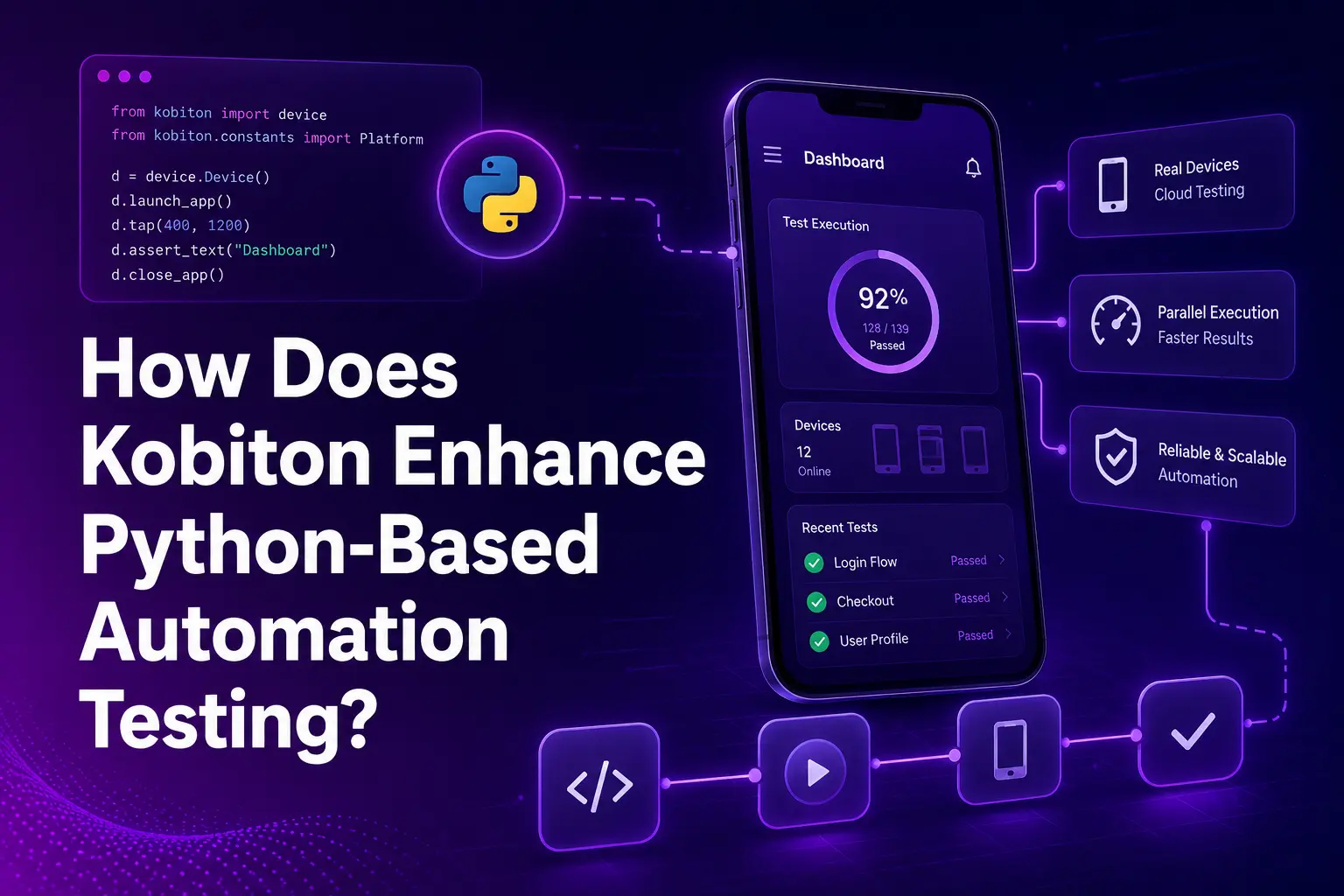
In the fast-paced world of software delivery, Python-based automation testing has become a powerful way to achieve speed, reliability, and scalability. With its simple syntax and rich library ecosystem, Python enables QA engineers and developers to build robust automation solutions.
However, enterprises often face challenges with scalability, real-device coverage, and CI/CD integration. That’s where Kobiton steps in, bridging the gap between open-source frameworks and enterprise-grade needs with real-device testing, AI-powered insights, and seamless DevOps integration, making it easier to compare Kobiton vs AI mobile testing solutions effectively.
The Python automation workflow on Kobiton
Twelve stages from test strategy to CI/CD. Pick a stage to see what to do, the code that does it, and the mistake that costs teams a sprint.
Why Python is Popular for Test Automation
Python is widely used for automation because it offers a gentle learning curve and readable syntax, supports multiple testing libraries and frameworks, integrates smoothly with CI/CD pipelines, and enables fast, maintainable, and reusable script development.
Popular Python Testing Frameworks
When choosing a Python automation framework, teams often rely on: Pytest, which is popular for simplicity and scalability with plugins and fixtures; Selenium with Python for web UI automation; Robot Framework, a keyword-driven framework supporting Selenium, Appium, and APIs; and Behave, a BDD framework using Gherkin syntax.
These frameworks are flexible but require device setup, maintenance, and scaling challenges that many enterprises struggle with.
The Challenge with Open-Source Alone
Open-source frameworks alone often result in limited real-device coverage, manual device lab management, flaky tests due to inconsistent environments, and complex CI/CD integration.
How Kobiton Enhances Python Automation Testing
Kobiton improves Python testing by combining open-source flexibility with enterprise scalability across several key areas.
Real-Device Testing at Scale: Access thousands of real iOS and Android devices in the cloud to validate scripts under real-world conditions.
Seamless Integration with Popular Frameworks: Use Pytest, Appium, Robot Framework, or Selenium with Python—Kobiton integrates without disrupting workflows.
AI-Powered Automation & Self-Healing: Kobiton’s AI auto-detects flaky tests and adapts locators dynamically, reducing maintenance.
CI/CD & DevOps Ready: Native integrations with Jenkins, GitLab, Azure DevOps, and more provide continuous feedback on every commit.
Comprehensive Test Insights: Get detailed analytics, logs, video recordings, and performance data for faster debugging.
Python Tools vs. Enterprise Platforms
Common Python automation tools include Selenium, Pytest, Robot Framework, Playwright, and Behave. While powerful, they lack scalability, real-device clouds, AI enhancements, and enterprise support that Kobiton delivers.
Best Practices for Python Automation with Kobiton
Start with functional and regression tests in Pytest or Robot Framework.
Validate scripts on Kobiton’s real-device cloud.
Integrate testing early into CI/CD pipelines.
Use AI-powered self-healing to minimize maintenance.
Combine scripting with low-code options for broader adoption.
Conclusion
Python automation testing provides flexibility, but enterprises need more scalability, reliability, and speed. Kobiton enhances Python testing with real-device access, AI-powered automation, and CI/CD integration, turning open-source scripts into enterprise-ready automation at scale.
Instead of choosing between open-source and enterprise platforms, teams can leverage both using Kobiton to ensure apps are delivered faster, more reliably, and at higher quality.
FAQs
What is Python-based automation testing?
Python-based automation testing uses Python scripts and frameworks to automate software tests, helping teams test faster and more consistently.
Which Python frameworks are commonly used for automation testing?
Common Python testing frameworks include Pytest, Selenium with Python, Robot Framework, Behave, and Playwright.
How does Kobiton support Python automation testing?
Kobiton supports Python automation by providing real-device testing, CI/CD integrations, AI-powered insights, logs, video recordings, and performance data.
Why use Kobiton with Python automation frameworks?
Kobiton helps overcome open-source limitations by offering scalable real-device access, better debugging, reduced test flakiness, and enterprise-level test execution.
Can Kobiton integrate with CI/CD pipelines?
Yes. Kobiton integrates with tools like Jenkins, GitLab, and Azure DevOps, allowing teams to run Python-based tests continuously with every code update.