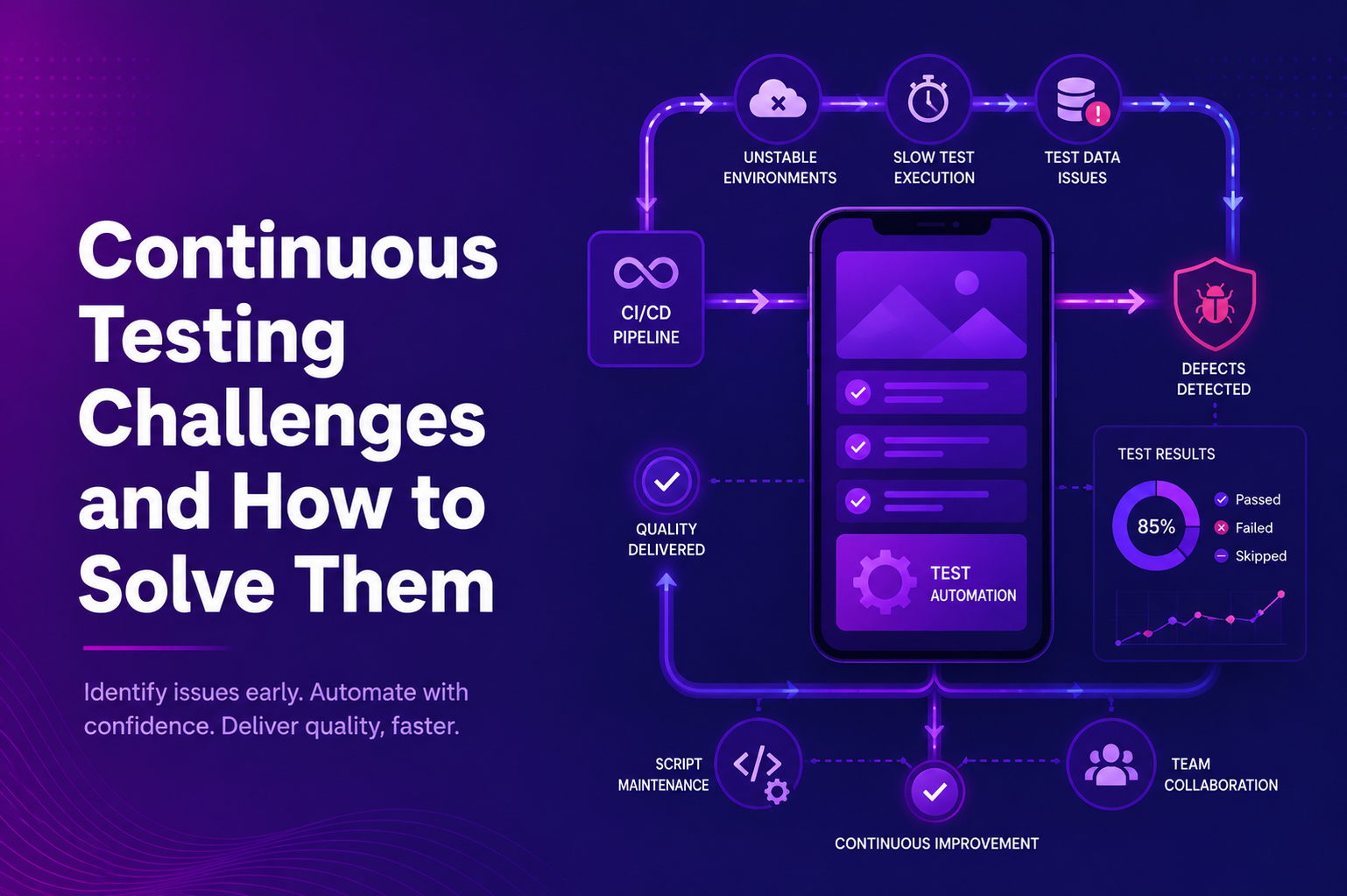
Continuous Testing is now a core part of modern software development. It allows teams to release faster without compromising quality. But in practice, many teams struggle to make it work smoothly. The issues are rarely just technical. They often involve process gaps, inconsistent environments, and limited team experience, along with some manual app testing challenges.
In this guide, we will break down the most common Continuous Testing challenges and show practical ways to solve them based on real-world workflows.
What is Continuous Testing?
Continuous Testing means running automated tests at every stage of the development lifecycle. Instead of waiting until the end of a release cycle, teams validate changes as soon as they are introduced. This enables teams to adopt more efficient continuous testing solutions that support faster and more reliable releases.
This approach helps catch issues early, reduces rework, and gives developers faster feedback. Over time, it also builds confidence in the stability of the application.
Common Continuous Testing Challenges
1. Lack of Proper Test Automation
One of the most common problems is relying too much on manual testing. While manual testing still has its place, it cannot keep up with frequent code changes in a continuous pipeline.
What works:
- Start with repetitive and time-consuming test cases
- Focus on critical user flows first
- Use stable and well-supported automation tools
For example, teams using platforms like Kobiton often begin by automating mobile regression tests, which saves hours of manual effort each release.
2. Unstable Test Environments
When test environments do not match production, results become unreliable. A test may pass in one environment and fail in another, creating confusion.
What works:
- Use containerization tools such as Docker to standardize environments
- Keep configurations consistent across development, staging, and production
- Monitor environments for unexpected changes
Consistent environments make test results more trustworthy and reduce false failures.
3. Slow Test Execution
As test coverage grows, execution time increases. Slow feedback makes it harder for developers to act quickly, which reduces the value of Continuous Testing.
What works:
- Run tests in parallel instead of sequentially
- Prioritize high-risk and business-critical scenarios
- Remove outdated or duplicate tests
Teams using Kobiton often speed up execution by running tests across multiple real devices at the same time, which significantly reduces feedback cycles.
4. Poor Test Data Management
Test data is often overlooked, but it directly affects accuracy. Using outdated or incorrect data leads to misleading results.
What works:
- Generate test data automatically where possible
- Mask sensitive data to stay compliant
- Regularly update datasets to reflect real-world scenarios
Clean and relevant data helps teams trust their test outcomes.
5. Integration Issues in CI/CD Pipelines
Integrating testing into CI/CD pipelines can be tricky. A small misconfiguration can break the entire workflow.
What works:
- Use consistent and well-documented CI/CD tools
- Review pipeline configurations regularly
- Make sure testing tools integrate smoothly with the pipeline
A stable pipeline allows Continuous Testing to run without interruptions.
6. High Maintenance of Test Scripts
Applications change frequently, and test scripts need to keep up. Poorly written scripts can quickly become a burden.
What works:
- Use modular and reusable test components
- Apply self-healing automation where possible
- Clean up outdated scripts regularly
This reduces long-term maintenance effort and keeps the test suite manageable.
7. Lack of Skilled Resources
Continuous Testing requires a mix of development, QA, and automation skills. Many teams struggle because they lack experience in one or more areas.
What works:
- Invest in training for both QA and development teams
- Encourage collaboration instead of working in silos
- Choose tools that are easy to adopt and scale
When teams understand both testing and development workflows, they can implement Continuous Testing more effectively.
Best Practices for Continuous Testing
To make Continuous Testing work consistently, keep these principles in mind:
- Start testing as early as possible in the development cycle
- Focus on risk-based testing instead of trying to test everything
- Monitor results continuously and act on failures quickly
- Review and improve your testing approach over time
Consistency and discipline matter more than tools alone.
Conclusion
Continuous Testing plays a major role in delivering reliable software at speed. While challenges are common, they are manageable with the right approach.
By improving automation, stabilizing environments, managing test data properly, and keeping pipelines clean, teams can build a testing process that supports faster releases and better user experience.
The key is to treat Continuous Testing as an ongoing practice, not a one-time setup.
FAQs
What is Continuous Testing?
Continuous Testing means running automated tests throughout the development lifecycle so teams can catch issues early and release software with more confidence.
What are the common challenges in Continuous Testing?
Common challenges include limited test automation, unstable test environments, slow test execution, poor test data management, CI/CD integration issues, script maintenance, and skill gaps.
How can teams speed up Continuous Testing?
Teams can speed it up by running tests in parallel, prioritizing high-risk scenarios, removing duplicate tests, and using real-device platforms like Kobiton for faster mobile test execution.
Why is test data management important in Continuous Testing?
Clean and realistic test data helps produce accurate results. Outdated or incorrect data can lead to misleading test outcomes and false failures.
How can Continuous Testing challenges be solved?
Teams can solve these challenges by improving automation, standardizing environments, managing test data properly, maintaining clean pipelines, using reusable scripts, and training QA and development teams.