In today’s highly competitive mobile app market, speed and quality go hand in hand. Teams are expected to release updates quickly while maintaining consistent performance across a wide range of devices. This balance is difficult to achieve with traditional testing methods alone. AI-driven mobile test execution is changing how teams handle this challenge by making testing faster, smarter, and more reliable.
What is Mobile Test Execution?
Mobile test execution is the process of running tests on a mobile application to validate its functionality, performance, and overall user experience. These tests can be manual, automated, or a combination of both.
Traditional approaches often depend on repetitive manual work or predefined automation scripts. Over time, these scripts become difficult to maintain as apps evolve. Even small UI or logic changes can break test cases, leading to delays and extra effort.
AI-driven mobile test execution takes a different approach. Instead of relying solely on fixed scripts, it adapts to changes in real time. This allows testing systems to respond to actual app behavior rather than rigid instructions, which makes the entire process more flexible and efficient.
The Role of AI in Mobile Test Execution
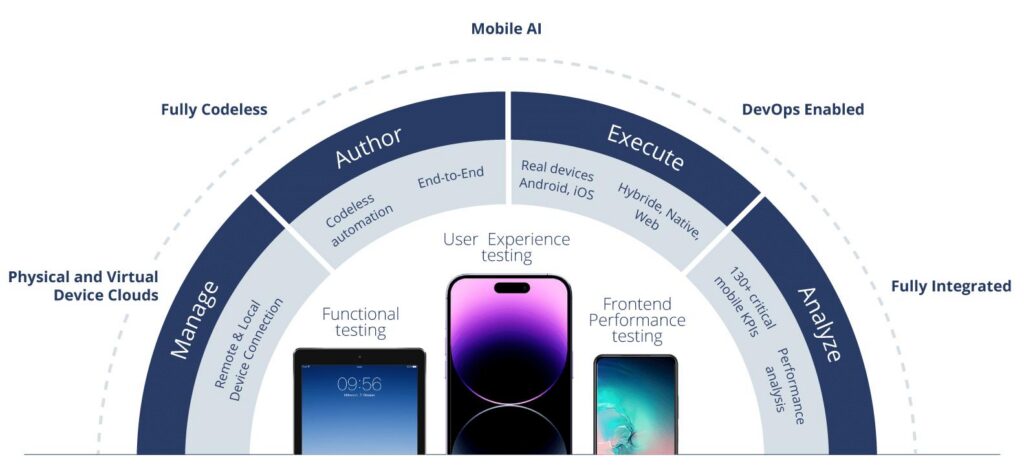
Artificial Intelligence introduces pattern recognition and decision-making into the testing process. Instead of simply executing predefined steps, AI can analyze how the app behaves and adjust testing accordingly.
With AI, testing systems can:
- Generate test cases based on real user interactions and usage patterns
- Identify high-risk areas in the application and focus testing efforts there
- Detect unusual behavior or performance issues early in the cycle
- Predict potential failures before they impact users
Platforms like Kobiton apply these capabilities in practical environments by combining AI insights with real device testing. This helps teams move beyond basic automation and focus on meaningful quality improvements.
The result is a faster feedback loop and reduced dependency on constant script maintenance.
Key Benefits of AI-Driven Mobile Test Execution
Faster Testing Cycles
AI can run a large number of tests across multiple devices at the same time. This significantly reduces execution time and allows teams to keep up with frequent release cycles without compromising stability.
Improved Accuracy and Reliability
By learning from previous test runs, AI identifies patterns that may not be obvious through manual testing. This leads to more consistent results and fewer issues slipping into production.
Resource Optimization
Instead of running every test repeatedly, AI prioritizes the ones that matter most. This reduces unnecessary effort and helps teams focus on areas that directly impact app performance and user experience.
Stronger Test Coverage
AI can simulate different user behaviors, network conditions, and device environments. This is especially valuable in mobile testing, where device fragmentation and OS variations can create unexpected issues.
Solutions such as Kobiton further strengthen this by providing access to real devices, ensuring that test results reflect actual user conditions rather than ideal scenarios.
Best Practices for Implementing AI in Mobile Test Execution
Start with High Impact Areas
Begin by applying AI to test cases that frequently break or require heavy maintenance. This delivers immediate value and builds confidence in the approach.
Use Real Devices Alongside AI
Testing on emulators alone is not enough. Combining AI with real device testing provides more accurate insights into how the app performs in real-world conditions.
Continuously Monitor Results
AI models improve over time, but they still require oversight. Regularly reviewing test outcomes helps keep predictions aligned with the current state of the application.
Integrate with CI and CD Workflows
AI-driven testing works best when it is part of the development pipeline. Integrating it into CI and CD processes allows teams to catch issues early and maintain a steady release flow.
The Future of Mobile Test Execution
As mobile applications grow in complexity, testing requirements will continue to expand. AI will play a larger role in handling this complexity by reducing manual effort and improving decision-making during test execution.
Advancements in machine learning and predictive analysis will make it possible to identify issues even earlier in the development cycle. Teams that adopt AI-driven mobile test execution will be better positioned to release stable applications quickly and respond to user expectations with confidence.
Final Thoughts
AI-driven mobile test execution is reshaping how modern teams approach app quality. Reducing repetitive work, identifying risks earlier, and improving test coverage allow teams to focus on delivering better user experiences.
For organizations aiming to stay competitive, adopting intelligent testing solutions is no longer optional. It is a practical step toward building reliable mobile applications while keeping development cycles efficient and predictable.
FAQs
What is mobile test execution?
Mobile test execution is the process of running tests on a mobile application to validate functionality, performance, stability, and overall user experience.
How does AI improve mobile test execution?
AI improves mobile test execution by generating smarter test cases, identifying high-risk areas, adapting to app changes, predicting failures, and reducing repetitive manual work.
What are the benefits of AI-driven mobile test execution?
The main benefits include faster testing cycles, stronger test coverage, improved accuracy, better resource optimization, and more reliable releases.
Why should teams combine AI with real device testing?
Combining AI with real device testing helps teams validate app behavior under real-world conditions, including device fragmentation, network variability, and operating system differences.
How can AI-driven testing be integrated into development workflows?
AI-driven testing can be integrated into CI/CD pipelines so tests run automatically during development, allowing teams to detect and fix issues earlier.