Every mobile QA team eventually faces the same fork between coded automation and scriptless mobile test automation. You can write it in code, or you can build it without code. Coded automation gives an engineer a programming language and full control. Scriptless mobile test automation lets a tester build the same checks by recording actions or describing them, no programming required. Both produce automated tests. They ask very different things from the people who write and maintain them.
The old caricature says scriptless is brittle record-and-playback and coded is the only serious option. That stopped being true over the last few years, once AI entered the picture. The real decision now is about who owns the tests, how much logic they carry, and how you keep them from breaking.
What coded mobile automation gives you
Coded automation means writing test scripts in a programming language against a framework like Appium, Selenium, Espresso, or XCUITest. You get the full power of the language: conditional logic, loops, shared page objects, data-driven runs, and clean integration with version control and CI.
driver.find_element(AppiumBy.ACCESSIBILITY_ID, "Sign in").click()
driver.find_element(AppiumBy.ACCESSIBILITY_ID, "email").send_keys("test@example.com")
assert driver.find_element(AppiumBy.ACCESSIBILITY_ID, "welcome").is_displayed()That control is the whole point. When a test needs to branch, call your own utilities, or express something unusual, code handles it without complaint. Appium and Selenium both build on the W3C WebDriver protocol, so the skills and tooling are portable and mature.
The cost is people and time. Coded suites need engineers to write them, review them, and maintain them. Manual testers who know the product best often cannot contribute directly, and every UI change means someone edits code to keep locators working.
What scriptless mobile test automation gives you
Scriptless mobile test automation, also called codeless mobile app testing, removes the programming barrier. A tester records a flow on a device, or composes it from visual steps, and the tool produces an automated test. No language, no framework setup, no locator syntax to learn.
The immediate win is reach. Your manual testers, the people who understand the app’s behavior best, can build and own automation directly. Authoring is faster because there is no code to write, and the tests read like the user journeys they represent. For smoke tests, happy-path regression, and broad functional coverage, that speed and accessibility are hard to beat.
The historical weakness was fragility. Record-and-playback tools from the 2010s captured brittle locators that broke on the smallest UI change, and they struggled with anything beyond a linear flow. Those limits are exactly what modern AI addresses.
How AI changed scriptless automation
The gap between scriptless and coded narrowed because AI moved into the authoring and maintenance layer. Three capabilities did most of the work:
- Self-healing locators. When an element’s identifier changes, the tool recognizes the failure and re-matches the element instead of breaking. Maintenance drops sharply.
- Computer vision and model-based capture. Tools observe a session and build a model of the app, so tests describe intent rather than fragile coordinates.
- Natural-language and record-based authoring. A tester performs or describes a flow, and the engine converts it into a runnable test.
Scriptless is no longer a synonym for brittle, which was the single biggest reason teams distrusted codeless tools. For broader context on AI mobile testing, see Kobiton’s mobile testing guide.
Scriptless vs coded: head-to-head
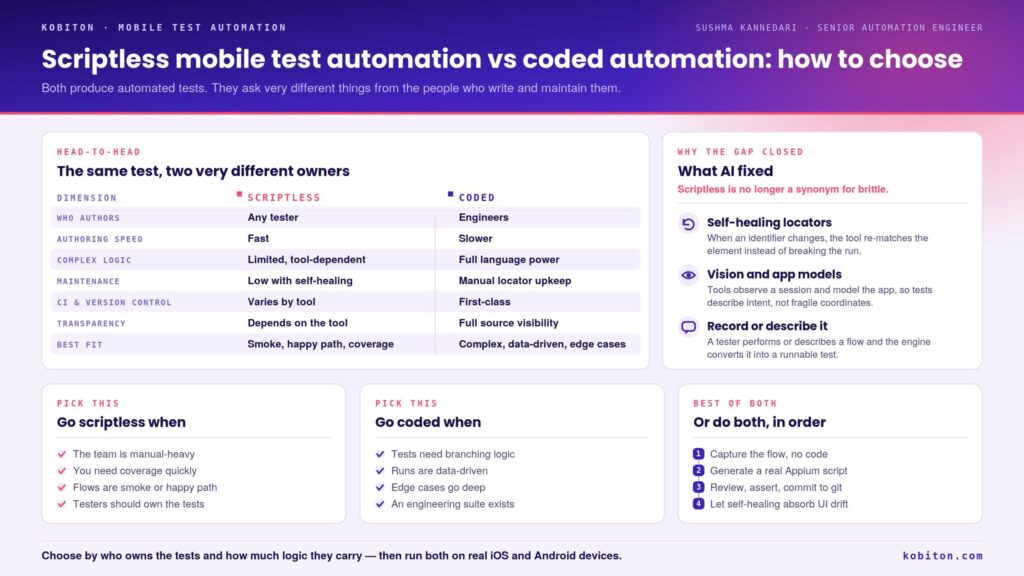
| Dimension | Scriptless | Coded |
|---|---|---|
| Who can author | Any tester | Engineers |
| Authoring speed | Fast | Slower |
| Complex logic | Limited, tool-dependent | Full language power |
| Maintenance | Low with self-healing | Manual locator upkeep |
| Version control and CI | Varies by tool | First-class |
| Transparency | Depends on the tool | Full source visibility |
| Best fit | Smoke, happy path, broad coverage | Complex, data-driven, edge-case suites |
The false choice: scriptless that generates real code
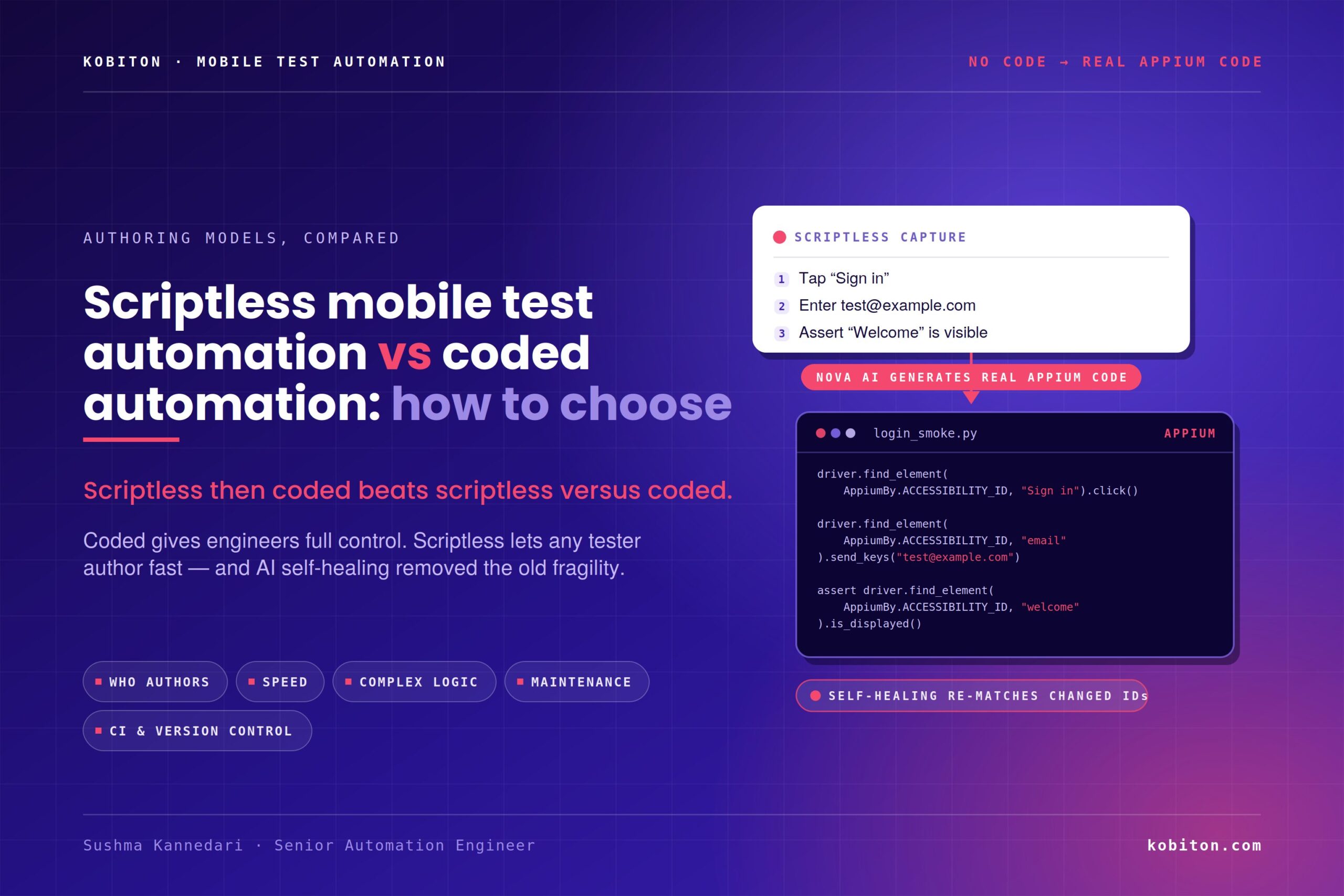
The framing of scriptless “versus” coded assumes you must pick one. The strongest platforms remove that assumption by generating real code from a scriptless session. A tester records a flow with no code, and the tool produces a genuine Appium script underneath.
The manual tester authors quickly and owns the test. The engineer inherits real Appium code they can read, extend, and check into version control. Nobody is locked into a black box, and the same test can graduate from a quick scriptless capture to a maintained coded asset without being rewritten.
When scriptless generates standard framework code, “scriptless vs coded” becomes “scriptless then coded,” which is a much better deal than either one alone.
From scriptless capture to maintained code
Moving a no-code capture into a maintained coded suite is a short, repeatable path:
- Capture the flow scriptless. A tester records the user journey on a real device, with no code.
- Generate the script. The tool converts that session into a real Appium script in a standard language.
- Review and harden. An engineer checks the generated locators, adds assertions or data-driven cases, and commits the test to version control.
- Let it self-heal. Self-healing keeps the script running through routine UI changes, so maintenance stays low between deliberate updates.
The tester never wrote code, the engineer never started from a blank file, and the result is a versioned asset the whole team can trust.
When scriptless mobile test automation is the right call
Use this quick heuristic:
- Manual-heavy team, fast coverage, smoke and happy-path flows: scriptless automation.
- Complex logic, data-driven runs, deep edge cases, an existing engineering suite: coded automation.
- Both: let testers author scriptless flows that generate Appium code, and let engineers maintain and extend the critical paths.
If you are still choosing a framework for the coded side, we compare the options in the best mobile testing tools and frameworks and in Selenium for mobile testing: where it works, and where Appium takes over.
Running scriptless and coded automation on real devices
Whichever side you start from, the tests still need to run somewhere real. Emulators and simulators miss the sensor, rendering, and fragmentation failures that only appear on physical hardware, which is why release-critical runs belong on real devices.
Kobiton bridges scriptless and coded directly with AI-powered mobile testing. Its NOVA AI engine captures a manual or exploratory session and turns it into an automated test, then generates a real Appium script from it, so a no-code capture becomes maintainable coded automation. Kobiton has generated open-standard Appium scripts from scriptless captures since 2020, well before the recent wave of AI testing tools. Appium self-healing keeps those scripts running when identifiers change by re-matching the element instead of failing. You can build tests with scriptless automation or bring your existing Appium and Selenium suites, and run either on real Android and iOS devices without changing your test code.
Bottom line
Coded automation gives engineers full control at the cost of engineering time. Scriptless mobile test automation gives any tester fast, accessible authoring, and AI has removed the fragility that used to hold it back. The sharpest teams stop treating them as rivals: they let scriptless capture generate real Appium code, so a test can start no-code and mature into a maintained coded asset. Choose by who owns the tests and how much logic they carry, and run both on real devices.
Build test flows with no code, or bring your own Appium and Selenium suites, on real iPhones and Android devices. Start testing for free.
Frequently asked questions
Is scriptless mobile test automation as reliable as coded automation?
Modern scriptless tools are far more reliable than early record-and-playback because of AI self-healing, which repairs tests when identifiers change. For smoke and functional coverage they are dependable. For deep, data-driven, or edge-case logic, coded automation still gives more control.
Can scriptless automation produce real Appium code?
Yes, on platforms built for it. Kobiton’s NOVA AI engine converts a scriptless or manual session into an executable Appium script, so a no-code capture becomes standard, maintainable code that engineers can extend and version-control.
Should manual testers use scriptless or coded automation?
Scriptless is usually the better entry point for manual testers, because it needs no programming and lets them automate the flows they already know. When a test needs complex logic, an engineer can take over the generated code.
What does self-healing fix, and what still needs a human?
Self-healing repairs a test when an element’s identifier changes, by re-matching the element, so routine UI tweaks no longer break runs. It does not replace human judgment for genuine functional changes: a new step in a flow, a changed business rule, or a redesigned screen still needs a person to update the test. Self-healing cuts maintenance noise so engineers spend their time on real changes.