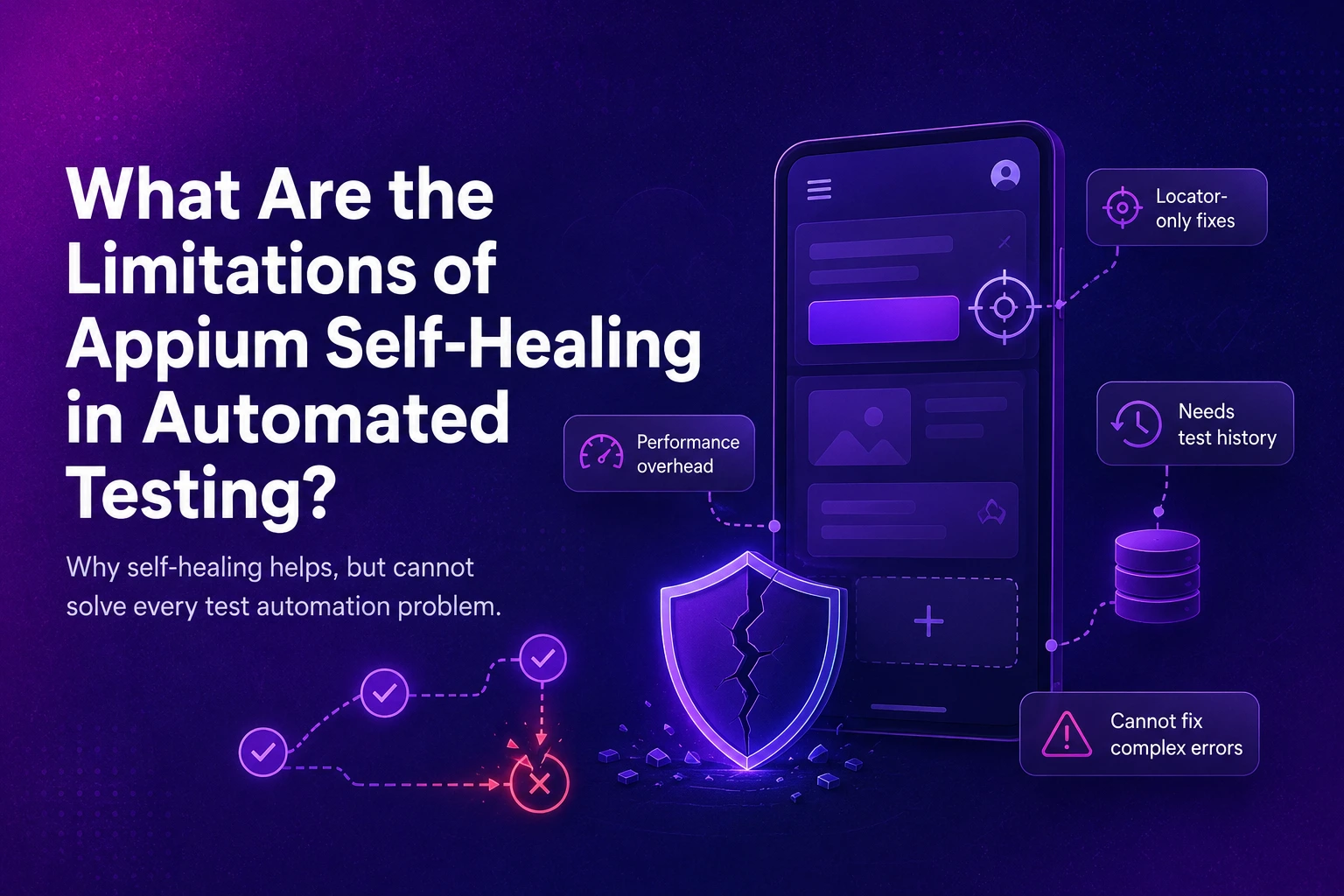
In the world of Appium test automation, one of the most sought-after features is self-healing. This powerful capability helps tests recover automatically from failures caused by dynamic changes in the application’s user interface. While it offers clear advantages, it also comes with several limitations that every tester should understand. Being aware of these constraints can help you build more reliable test suites and maintain smoother automation workflows. Let’s explore these limitations and how they can affect test stability.
1. Limited Scope of Recovery
One of the main challenges with Appium self-healing is that it is not effective in every scenario. The mechanism relies heavily on element locators. When a locator changes due to a UI update, self-healing attempts to find an alternative. However, if the change is too significant, such as a complete removal of the element or major alterations in attributes, the mechanism may fail to recover. While self-healing can handle common issues, more complex UI changes can still result in test failures that require manual intervention.
2. Performance Overheads
Although self-healing improves test stability, it introduces additional processing during execution. The system must dynamically evaluate and adjust locators at runtime, which adds extra steps to each test. As a result, execution times can increase, especially in scenarios where self-healing is frequently triggered. In large-scale Appium automation projects, this overhead can impact the efficiency of CI/CD pipelines and potentially slow down release cycles.
3. Reliance on Previous Successful Tests
Self-healing depends on previously successful test executions to learn and store valid locators. Without this historical reference, the mechanism has limited ability to recover from failures. This becomes problematic in cases where locators change frequently or dynamically across test runs. If the stored locator becomes outdated, self-healing may attempt recovery using incorrect or irrelevant data, leading to inconsistent results and reduced test stability.
4. Inability to Handle Complex Errors
Appium self-healing is primarily designed to address locator-related issues and cannot resolve more complex problems. Errors related to environment setup, system failures, or configuration issues fall outside its scope. For example, if there is a WebDriver initialization failure or the application fails to launch, self-healing cannot intervene. These situations require manual debugging and resolution, which can offset the time-saving benefits of automation.
5. Inconsistent Test Results
While self-healing can successfully recover from minor UI changes, it can sometimes hide deeper issues within the application or test scripts. Frequent locator adjustments may lead to false positives, where tests pass even though underlying problems still exist. This can create a misleading sense of reliability and make it harder for testers to identify root causes. Over-reliance on self-healing may also reduce the emphasis on proper test design and debugging practices.
6. Compatibility Issues
Although Appium supports multiple platforms, self-healing behavior may vary across different environments. For instance, it may perform well on Android but face limitations on iOS due to differences in how UI elements are structured and identified. Since self-healing relies on consistent locator behavior, any platform-specific inconsistencies can reduce its effectiveness and add complexity to cross-platform testing.
7. Limited Coverage of Complex Interactions
Self-healing is mainly focused on resolving locator failures and does not extend well to complex user interactions. Tests that involve multi-step workflows, dynamic content, or conditional logic are harder for self-healing to manage. For example, interactions with pop-ups or dynamically loaded elements often require custom logic rather than simple locator adjustments. In such cases, self-healing alone is not sufficient to ensure test reliability.
Conclusion
Appium self-healing is a valuable feature that enhances automation by reducing failures caused by minor UI changes. However, it is not a complete solution for all testing challenges. To build a robust automation framework, self-healing should be used alongside well-designed test strategies, stable locators, and regular maintenance. By understanding its limitations and using it strategically, you can maximize its benefits while avoiding potential pitfalls.
FAQs
What is Appium self-healing?
Appium self-healing helps automated tests recover when UI element locators change due to minor app updates.
What is the main limitation of Appium self-healing?
Its main limitation is that it mostly works for locator-related issues and cannot fix major UI changes or missing elements.
Can Appium self-healing slow down tests?
Yes, because it adds extra processing during test execution when it tries to find alternative locators.
Does self-healing fix all Appium test failures?
No, it cannot fix issues like environment setup errors, WebDriver failures, app launch problems, or configuration issues.